
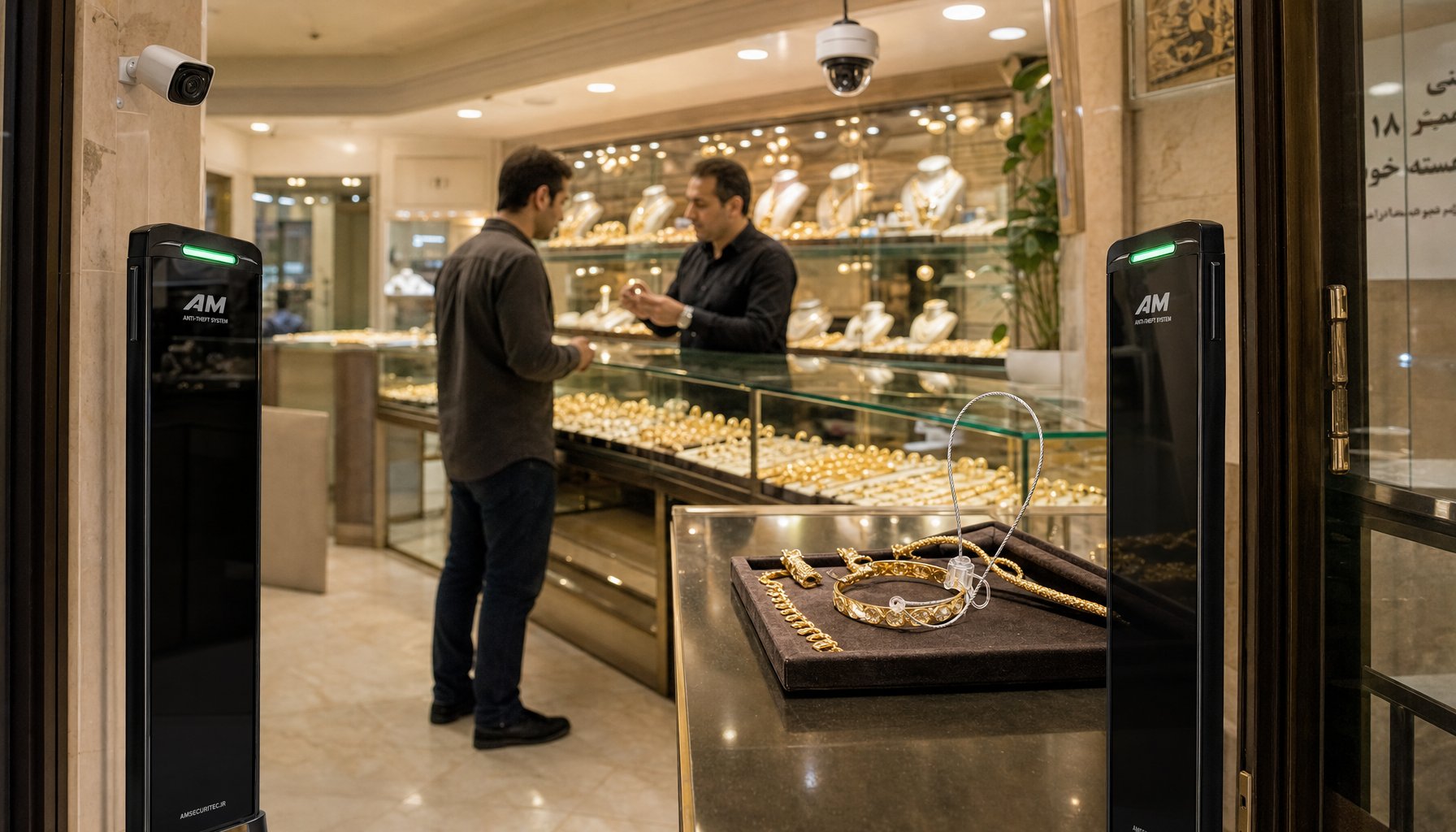
Jewelry Store Security: EAS Gates, Tags & CCTV
A jewelry display case holds the densest concentration of capital any retail business can put on show in a few square meters. A single tray of rings can be worth as much as an entire apparel store's back-room inventory, and that changes the security equation completely. In an ordinary shop, losing one item is a rounding error; in a jewelry store, a single missing piece can wipe out months of profit. That is why jewelry display security is never handled by one product on its own. It has to be designed as a layered system: an EAS gate at the door, security tags and labels on the merchandise itself, and CCTV cameras framed intelligently on the cases.
Why jewelry security is different from other retail
Look at how theft actually happens in jewelry stores and three differences stand out. First, the value-to-size ratio: a bracelet weighing a few dozen grams disappears inside a closed hand, yet it is worth as much as a television. Second, the nature of the sale itself: the associate has to unlock the case, place the piece on the counter, and let the customer try it on. That moment is the most vulnerable point in the entire store. Third, organized and team theft: in many cases one person keeps the associate talking while a second moves the piece.
- Theft during a presentation: a piece is pocketed or swapped in the few seconds the associate's attention drifts.
- Theft from an open display: a piece lifted from a tray sitting outside a locked case.
- Swap with a fake: the genuine piece replaced with a look-alike replica.
- Internal theft: gradual shrinkage that only surfaces through stock counts and recorded video.
No single product covers all four scenarios. The gate stops a tagged piece from leaving, the tag is what makes it detectable, and the camera turns the incident into evidence you can act on.
Layer one: an EAS gate at the jewelry store entrance
The EAS gate is the store's last physical line of defense. Its job is simple but critical: if a piece with a live tag passes through the gate's aisle, the audible and visual alarm fires. The deterrent effect matters even more than the detection. When a professional thief sees two pedestals standing in the doorway, they reprice the risk on the spot.
AM or RF: which technology suits a jewelry store?
There are two main families of gate on the market: AM (acousto-magnetic, 58 kHz) and RF (radio frequency, 8.2 MHz). For jewelry, the deciding factor is the sheer amount of metal in the environment, from metal-framed cases to the safe and the merchandise itself.
| Feature | AM gate | RF gate |
|---|---|---|
| Operating frequency | 58 kHz | 8.2 MHz |
| Aisle width per pair | Up to about 2 m | About 1.2 to 1.6 m |
| Tolerance of metal interference | Very high | Moderate |
| Works with small, fine tags | Excellent | Limited |
| False alarm rate | Low | Higher |
| Recommendation for jewelry | First choice | Fallback option |
In practice, jewelry stores with metal-framed cases and a narrow entrance are safer with AM. Its magnetic field is far less disturbed by surrounding metal, and the false alarm rate, which is the number one reason staff end up switching a gate off permanently, is significantly lower. You can browse and compare AM and RF gate models that fit tight entrances in the retail gate section of vista-eas.com.
Installation details that get overlooked
- Keep the gate at least 1 m away from metal doors, roller shutters and large metal signage.
- Do not run high-voltage power cable or air-conditioning wiring underneath the pedestal.
- Tune the sensitivity after the display cases are in their final positions, not before.
- Wire the gate's alarm relay output into the recorder so every alarm creates a video bookmark.
Layer two: anti-theft tags and labels built for jewelry
A gate without tags is just a decorative frame. But a jewelry tag is fundamentally different from a clothing tag: it must not scratch the surface, must not be heavy, and must not spoil how the piece looks in the case. That is why jewelry stores use several tag families.
- Lanyard tags: attached with a fine cable to a bracelet, watch or chain, arming the piece without touching or marking the surface.
- 40x40 soft labels: ideal for boxes, warranty cards and gift packaging, at a very low cost per unit.
- Small clear tags: applied to the price ticket or the item card, where they stay out of the customer's eyeline.
- Security trays and boxes: for high-value pieces that only leave the case with an associate present.
A practical rule: anything within direct reach of a customer should be armed, even inside a glass case. Experience shows most losses happen not from behind locked glass but from the trays brought out onto the counter for a presentation. The detacher should live at one fixed position behind the till and never be left on the counter in front of customers. Hard tags, soft labels and magnetic detachers compatible with both AM and RF are available at vista-eas.com.
Layer three: CCTV, a fixed eye on the display case
In a jewelry store the camera plays the role of proof. The gate stops the exit, the tag identifies the item, but only footage establishes what happened, who was involved, and at which second. The common mistake is mounting cameras for a wide general view, so that when someone reviews the recording, faces and hands are impossible to make out.
A camera layout that works in a jewelry store
- Face-capture camera at the door: mounted at roughly 160 cm and facing the entrance, so every person who walks in is recorded head-on rather than from a steep ceiling angle.
- Over-the-counter camera: angled down from above so the associate's hands, the customer's hands and the tray surface are all in frame at once. This is the single most important camera in the store.
- Display case cameras: every case should sit in the frame of at least one 4 MP or higher camera.
- Safe and stockroom camera: to cover every movement of inventory in and out.
- Exterior camera: for license plates and foot traffic outside the door.
Three technical points usually get forgotten. First, heavy display lighting creates backlight and turns faces into silhouettes, so the camera needs genuine WDR. Second, retention for a jewelry store should never be under 30 days; internal theft is often discovered weeks after the fact. Third, the recorder belongs in a locked enclosure out of sight, ideally with cloud backup or mobile streaming enabled.
Combining the three layers: where real security starts
The strength of this architecture is in the overlap, not in any single component. When the gate's alarm output is wired to the recorder, every alarm automatically saves a 30-second clip either side of the event, so nobody has to scrub through hours of footage. When store policy is that no untagged piece ever reaches the counter, the swap-with-a-fake scenario effectively disappears. And when the counter camera is framed correctly, disputes with customers are settled in minutes.
| Threat scenario | Gate | Tag | Camera |
|---|---|---|---|
| Item carried out of the store | Full coverage | Full coverage | Evidence |
| Theft during a counter presentation | Indirect | Full coverage | Full coverage |
| Genuine piece swapped for a fake | — | Full coverage | Full coverage |
| Internal staff theft | — | Partial | Full coverage |
| Psychological deterrence | Full coverage | Partial | Full coverage |
Rollout checklist for jewelry store security
- Draw a floor plan and mark the path a customer takes from the door to the counter.
- Measure the entrance width precisely; anything over 2 m means you need a second gate aisle.
- Split your inventory into three groups: open display, shown with an associate, and safe only.
- For the first two groups, choose a tag type that suits the shape of each piece.
- Test camera blind spots by standing in the store and watching the monitor, not by looking at a drawing.
- Write a staff protocol: one tray on the counter at a time, detacher behind the till only.
- Run a walk-through test with a tagged piece every month to confirm the gate is still healthy.
- Sync your barcode scanner and thermal printer with your inventory system so weekly stock counts are realistic.
Cost versus risk
A starter package, with one AM gate aisle, enough lanyard tags and labels, one detacher and a set of interior cameras, usually costs less than one or two mid-range pieces in your display case. In other words, if the system stops a single theft over its entire lifetime, it has already paid for itself. More importantly, many theft insurance policies require an alarm and video recording system as a condition of paying out, so the investment buys legal standing as well as prevention.
If you want to know exactly which combination of gates, tags and cameras suits your floor area and layout, the Vista Gate team will review your store plan and put together a technical and pricing proposal built around it. Just fill in the consultation form at vista-eas.com or call our support line, and you can have your display security plan finalized today. Installation and staff training are on us.