Retail Security Gate Range: How Wide Can an Aisle Be?
When the owner of a clothing store or a hypermarket starts shopping for a retail security gate for the first time, the first question is almost always the same: "How wide a doorway will this gate actually cover?" The short answer is that a retail security gate covers anywhere from 90 to 210 cm per aisle, and it comes down to three things: the gate technology (AM or RF), the type of tag or label attached to your merchandise, and the environmental conditions where it is installed. But the more precise and far more useful answer is the one you'll work through step by step below: how to measure the entrance width of your store and use that number to choose the right pedestal count and the right technology — so you neither overpay nor end up with an anti-theft system that only half does its job.
What does gate range actually mean, and where is it measured from?
The range of a retail security gate is the greatest distance two pedestals (antennas) can sit apart while still reliably detecting a tag that passes between them. That figure is measured from the inner edge of one pedestal to the inner edge of the one facing it — not center to center. This is exactly where a lot of buyers trip up: they measure the full span from the middle of each pedestal and quietly lose 10 to 16 cm of usable walkway.
The second thing to understand is that range isn't a straight line — it's a detection volume. The electromagnetic field between two pedestals is shaped like an ellipse, and it's strongest between waist and chest height (roughly 80 to 120 cm off the floor). That's why a tag carried at ankle height or held above head height can slip through undetected, even in an aisle that is comfortably within the rated range on paper. The industry standard is that a quoted range must hold a detection rate above 95 percent — not just work under ideal lab conditions.
How much range do AM and RF gates have?
The two technologies you'll encounter are AM and RF, and the gap between their ranges is significant. If you're torn between the two, the retail security gates category page at vista-eas.com offers a fuller side-by-side comparison of what each one is built for.
AM gates at 58 kHz
AM (acousto-magnetic) gates deliver the longest range. With a standard hard tag, a single aisle can open up to 210 cm and still detect dependably. Switch to a soft (DR) label and that figure drops to 120–150 cm. The big advantage of AM is its resilience against electrical noise, LED signage and power cabling — which is why it's the default choice in hypermarkets and large chain stores.
RF gates at 8.2 MHz
RF gates cost less and are the more economical pick for boutiques, bookstores and stationery shops. Range runs 140–180 cm with a hard tag, and 90–130 cm with a 4×4 cm paper label. If your entrance is under 150 cm and you aren't selling metal or liquid products, RF will serve you perfectly well.
Gate range by technology and tag type
| Technology | Tag type | Effective range per aisle | Best suited to |
|---|---|---|---|
| AM 58 kHz | Hard tag | 180 to 210 cm | Apparel, sportswear, hypermarkets |
| AM 58 kHz | DR soft label | 120 to 150 cm | Supermarkets, pharmacies, cosmetics |
| RF 8.2 MHz | Hard tag | 140 to 180 cm | Apparel, bags and footwear |
| RF 8.2 MHz | 4×4 paper label | 90 to 130 cm | Bookstores, stationery, boutiques |
The figures in this table are effective ranges — meaning the detection rate stays above 95 percent. The "maximum" range some vendors quote is usually 20 to 30 cm higher, but at that spacing you start losing tags held close to a customer's body or tucked inside a bag.
Measuring your entrance width in four steps
Now for the part that matters. To work out how many pedestals you need, follow these four steps exactly:
- Step one — measure the clear opening: using a steel tape, measure the distance between the two walls or door frames at a height of one meter off the floor. That one-meter height matters; baseboards and steps make a floor-level measurement misleading.
- Step two — subtract the unusable width: if you have sliding glass doors, deduct the panel that stays fixed. Only the path customers actually walk through counts.
- Step three — pick your effective range: take the figure from the table above that matches your technology and tag. For AM with hard tags, for example, work from 190 cm.
- Step four — apply the formula: the number of pedestals equals (clear width divided by effective range) plus one, rounded up to the next whole number.
Here's a real example: a clothing store with a clear opening of 380 cm using AM hard tags. The math is 380 divided by 190 equals 2, plus one — so 3 pedestals, forming two aisles of 190 cm each. Had that same store gone with RF and labels, the effective range would have been 110 cm and it would have needed 5 pedestals: more money spent, and a more cluttered entrance. This is precisely where choosing the right technology pays you back.
How many pedestals does my entrance need?
| Clear entrance width | Recommended pedestals | Number of aisles |
|---|---|---|
| Up to 150 cm | 2 pedestals | 1 aisle |
| 150 to 210 cm | 2 AM pedestals or 3 RF pedestals | 1 or 2 aisles |
| 210 to 400 cm | 3 pedestals | 2 aisles |
| 400 to 600 cm | 4 pedestals | 3 aisles |
| Over 600 cm | 5 pedestals or more | 4 aisles and up |
Note that in a multi-aisle setup the middle pedestal serves both sides at once — that's why the "plus one" formula works and why you don't need to buy two separate pedestals for every aisle. In a large store, that single detail can change the quote by tens of millions of tomans.
What shortens a retail gate's range
The range printed in the catalog is range under ideal conditions. On a real site, these factors cut into it:
- Metal near the pedestals: a metal door frame, railings, a display case with an aluminum frame — and above all rebar in a concrete floor — can eat up to 25 percent of your range. Keep at least 30 cm of clearance from any large metal surface.
- Sources of electrical noise: LED advertising displays, automatic door motors, lighting transformers and display refrigerators. RF gates are considerably more sensitive to this than AM.
- A second anti-theft system nearby: if the shop next door also has gates and they sit less than three meters away, you'll get frequency interference and the systems will need to be phase-synchronized.
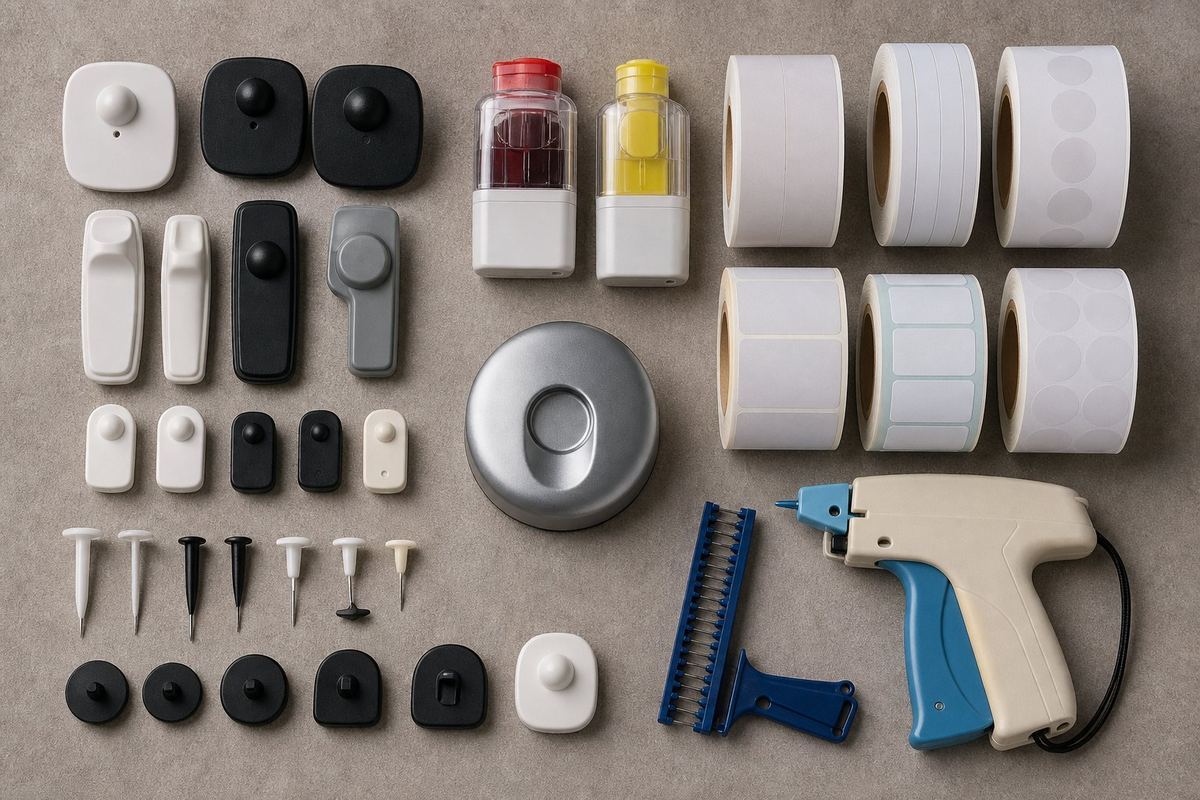
- Tag orientation: AM tags are far less direction-sensitive, but an RF label can go undetected if it passes perfectly parallel to the antenna. The label and hard tag range in the Tags & Labels category at vista-eas.com has been selected and organized with exactly this in mind.
- Voltage drops and unstable power: in stores with fluctuating mains power, gate range noticeably falls off during peak hours. A dedicated voltage protector for the gate is well worth it.
Common mistakes when calculating entrance width
On site visits, these four mistakes come up more than any others. Avoid them and more than half of all "my gate doesn't work properly" complaints disappear.
- Measuring from pedestal centers instead of inner edges: the result is an aisle that's correct on paper and cramped in practice.
- Ignoring the emergency exit route: safety regulations set a minimum passage width, and your gates must not encroach on it.
- Buying based on maximum range: if you don't design around effective range, the system will come up short on your busiest trading days — exactly when most theft happens.
- Overlooking what you sell: a store carrying foil, metal cans or liquids needs to calculate range more conservatively, and usually should go with AM.
If your entrance is non-standard — L-shaped, stepped, or with a column in the middle — the simple formula won't cut it and the entrance layout needs to be reviewed properly.
The bottom line, and where to get advice
Retail gate range isn't a fixed number; it's the product of technology, tag type and site conditions. For most stores, AM with hard tags and an effective range of around 190 cm is the safe choice, while RF makes sense for narrower entrances and tighter budgets. Measure your entrance at one meter off the floor, take the effective range from the table, and run the "divide, then add one" formula.
If you want certainty before you buy — how many pedestals you need and which technology suits your merchandise — the Vista Gate team will assess your store entrance free of charge and come back with a precise recommendation and a price. Just tell us your entrance width and what you sell. Get in touch through the contact page at vista-eas.com, or leave your number and we'll call you back within one working day.