
Anti-Theft Tags for Gold & Jewelry: Types and Fitting
A jewelry store is one of the few businesses where enormous value is packed into the smallest possible space. A ring weighing a few grams can be worth more than an entire supermarket trolley, and it can disappear into a closed fist in a fraction of a second. That is why an anti-theft tag for gold and jewelry is no longer a luxury add-on in a display case; it is part of the security baseline for any jewelry store or gallery. In this article we walk through the tag types that suit gold pieces, the right way to fit them on chains, rings, bracelets and watches, and how to look after your tags over the long term.
Why jewelry stores need purpose-built anti-theft tags
In a clothing store you clip a hard tag through a seam and you are done. A jewelry store, however, has three serious constraints that make ordinary tags useless:
- Product size: a ring or a pair of earrings simply has no room for a standard hard tag; the tag has to be small, light and pin-free.
- Surface sensitivity: 18-karat gold is a soft metal. Any clamping jaw or unsuitable adhesive can leave a scratch or a mark on a polished surface, and that alone lowers the value of the piece.
- Metal interference: metal reflects and weakens both magnetic and radio fields. A tag that performs perfectly on fabric may not be picked up by the gate at all once it sits directly against gold.
Tag selection in this trade is genuinely specialised, and you cannot simply copy what works in a clothing store. The specialists at Vista Gate on vista-eas.com usually ask about your stock mix (how much of it is chains, rings, watches and matching sets) before recommending a model, because that mix is exactly what determines the right tag.
Types of anti-theft tags for gold and jewelry
The tags you can use in a jewelry gallery fall into a handful of families. Each one is built for a specific part of your display:
1. Mini pin (butterfly) tags
The smallest version of the hard tag, typically around 25 x 15 mm and under 5 grams. The pin is very fine, and instead of piercing the item it passes through a chain link or a watch-strap buckle. A good fit for wristwatches, leather bracelets and the accessory pieces a gallery carries.
2. Lanyard (cable) tags
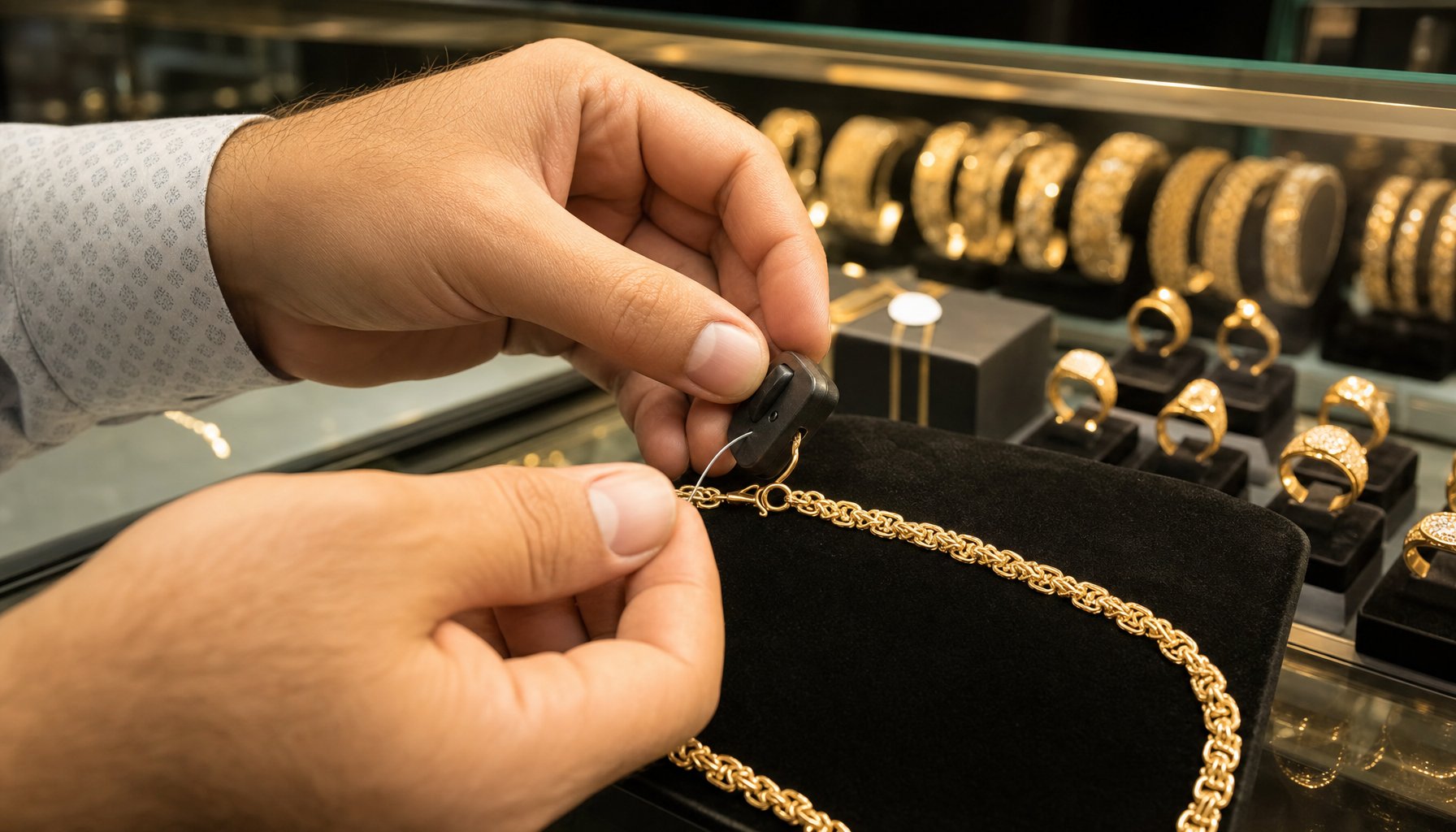
With this design, a coated steel cable is threaded through the item and both ends lock into the tag body. It is the best choice for chains, necklaces, bangles and bracelets, because it puts no pressure on the gold at all — it simply loops around it. The cable normally has a clear plastic coating so it cannot scratch the gold surface.
3. Metal-friendly soft labels
Standard labels perform poorly on metal, but metal-friendly versions carry a foam or ferrite layer between the label and the metal surface that cancels out the interference. These labels can go under a box, on the back of a pendant, or on the warranty card. They are consumable and usually sold in packs of 1,000.
4. Tags for rings and display boxes
For rings, the most common practical approach is to tag the display stand or the box rather than the ring itself. A small pin tag is attached to the velvet cushion inside the box; if anyone tries to walk out with the box and its contents, the gate sounds.
5. Self-alarming tags (EAS + alarm)
A newer generation of tags with a built-in siren. If someone tries to force the tag off or cut the cable, it sounds right there on the spot — before they ever reach the exit. Highly effective for open, self-service displays and jewelry trade shows.
Quick comparison of tag types for gold pieces
| Tag type | Best for | Risk of damage | Reusable |
|---|---|---|---|
| Mini pin (butterfly) | Watches, leather bracelets, straps | Low | Yes |
| Lanyard cable tag | Chains, necklaces, bangles | Very low | Yes |
| Metal-friendly label | Boxes, pendants, cards | None | No (consumable) |
| Tag on display box | Rings, matching sets | None | Yes |
| Self-alarming tag | Open displays, trade shows | Low | Yes |
AM or RF: which technology suits a jewelry store?
Before buying tags you need to settle the question of the security gate, because tags and gates have to run on the same frequency. Two technologies dominate the market:
- AM at 58 kHz: noticeably more stable in metal-heavy environments and produces fewer errors around glass cabinets with metal frames. This is our first recommendation for jewelry stores.
- RF at 8.2 MHz: cheaper, with more affordable labels, but far more sensitive to metal and to sources of electrical noise.
In galleries with metal cabinets, safes and plenty of LED lighting, our installation experience consistently shows that AM gates generate fewer false alarms. The Vista Gate range of retail security gates is available in both technologies, and you can review the models and full specifications at vista-eas.com.
How to fit tags on gold pieces correctly
Fitting a tag badly damages the piece and defeats the security at the same time. Work through these steps:
- Step 1 — Clean the surface: before applying a label, wipe the box or pendant with a lint-free cloth. Finger grease cuts label adhesion roughly in half.
- Step 2 — Pick the attachment point: on a chain, pass the tag cable through the clasp, never through the middle of the weave; pressure on fine links will pull the weave open.
- Step 3 — Keep clearance from metal: if you have no choice but to stick a label onto a metal surface, always use the foam-backed type so you get at least 2 mm of air gap.
- Step 4 — Lock it fully: once the tag is seated, give it a gentle pull. If there is any play, the pin has not engaged properly.
- Step 5 — Walk-through test: carry the tagged item through the gate. A live test beats guesswork every time.
- Step 6 — Train the cashier: the magnetic detacher must live in one fixed spot behind the counter and should never be left lying on the countertop.
One important warning: never rest a tag against delicate stone settings, enamel work or natural gemstones. The mechanical pressure of the clamp can shift a stone, and this kind of damage usually goes unnoticed at the moment it happens.
Caring for your tags and extending their service life
A hard tag is an electromechanical component, and looked after properly it will last for years. To keep them in good shape:
- Collect removed tags in a dedicated box or tray rather than throwing them into a crowded till drawer; knocks and scratches on the housing reduce the sensitivity of the core inside.
- Keep tags away from strong magnets, loudspeakers and electric motors. An intense magnetic field can deactivate an AM tag permanently.
- Run a sample test every month: pass 10 random tags through the gate and record how many alarm. If even one stays silent, pull that entire batch out of service.
- Inspect the cables on lanyard tags; a split coating both scratches gold and signals metal fatigue underneath.
- Store soft labels somewhere dry and out of direct sunlight. Moisture weakens the adhesive and disrupts the circuit inside.
- Do not park the magnetic detacher on a metal surface, and protect it from being dropped; a drop in field strength is the first sign of failure.
Common mistakes in jewelry stores
On site visits, these are the errors we see repeated most often:
- Tagging only the expensive pieces: a professional thief takes the untagged item first. Coverage has to be uniform.
- Installing the gate too close to a metal safe: less than a metre of clearance from large metal surfaces drastically cuts the gate detection range.
- Switching the gate off at busy times: if you are getting too many false alarms, the problem is the sensitivity setting, not the system itself; switching it off reduces your security to zero.
- Relying entirely on cameras: a camera records, it does not prevent. It is the combination of gate + tag + CCTV that genuinely lowers your risk.
- Buying low-quality tags: a cheap tag with a weak core will not be detected beyond about 80 cm from the antenna, which makes it little more than decoration.
Cost and return on investment
When you budget, treat three items separately: the gate (a one-off capital cost), hard tags (capital cost, reusable for several years) and soft labels (consumable). For a gallery with a single entrance, one pair of AM antennas plus 200 to 300 hard tags typically covers the initial requirement.
The economics are simple: in a jewelry store, preventing a single successful theft usually pays for the entire system. To see the available tag, gate and CCTV camera models and get current pricing, visit vista-eas.com.
Summary and free consultation
Choosing an anti-theft tag for gold and jewelry comes down to balancing three things: real security, the condition of the piece, and convenience for your staff. Once you understand lanyard tags, mini pin tags, metal-friendly labels and self-alarming tags, and you follow the fitting and maintenance basics, you can bring theft risk right down without so much as marking a single piece of gold.
If you are not sure which combination suits your display, talk to the Vista Gate specialists today. We will look at your stock mix, your entrance width and the conditions in your store, then recommend a solution that fits your budget. The initial consultation is free, and you can place your order through the contact form at vista-eas.com or by calling the store directly.