Small Boutique Anti-Theft: The Cheapest Setup That Works
If you run a small boutique, you have probably asked yourself this more than once: “My shop isn't that big — do I really need an anti-theft system?” The short answer is that being small is exactly why you do. In this guide we'll show you the cheapest combination of retail security equipment that actually works in a small-footprint store, what you can safely leave out, and where cutting costs quietly kills the whole system.
Why small boutiques are an easier target
Most people assume shoplifting is a problem for hypermarkets and chain stores, but what we see on the ground says otherwise. A 25 to 60 square metre boutique with one or two staff is the lowest-risk option a professional shoplifter can find. The reasons are simple:
- CCTV usually just records — nobody is watching the feed live, so there is no deterrent in the moment.
- At busy times your one salesperson is serving another customer, working the till and answering the phone all at once.
- The fitting room is a complete blind spot, and in apparel that is exactly where most theft happens.
- In a boutique, every single item carries real value. One coat or jacket can wipe out several days of profit.
Here's the part that matters financially: a large store absorbs shrinkage across a huge sales volume. In a small boutique, losing three or four high-value pieces a month comes straight out of your margin. That's why a simple anti-theft system usually pays for itself faster in a small shop than in a big one.
What a small boutique anti-theft system is actually made of
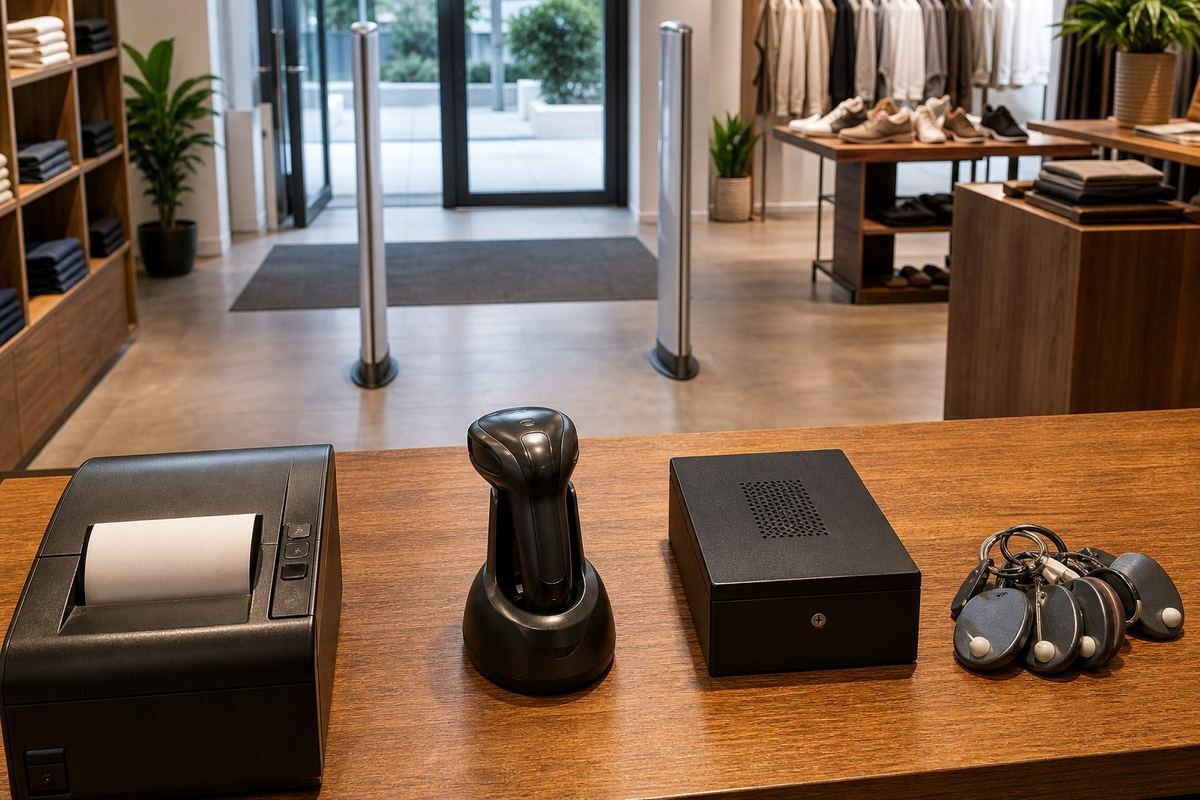
When we say “retail security system,” we don't just mean the two pedestals by the front door. It's a four-part setup, and if you drop one part, the rest stop working too.
1. The security gate (EAS antenna)
These are the pedestals installed at the entrance that sound an alarm when a live tag passes through. For a small boutique, the material matters: clear acrylic gates make a tight space feel more open, while metal or MDF gates give the entrance a heavier look. For doorways under 120 cm, a single-pedestal (single-antenna) unit mounted against the wall is enough — and noticeably cheaper.
2. Hard tags or soft labels
In apparel, hard tags (shell tags, pencil tags and mini tags) are the main choice, because they're reusable: you remove one at the till and put it straight onto the next garment. Buy once, use for years. Soft labels (adhesive paper labels) are better suited to add-ons like socks, packaged scarves, cosmetics and accessories, and they're a consumable.
3. The detacher (tag remover)
A magnetic unit that sits on the counter and releases hard tags. This one isn't optional — without it you literally can't hand a sold item to the customer.
4. The deactivator (label deactivator)
Only needed if you use soft labels. If your boutique sells clothing only and everything is covered by hard tags, you can skip this for now and add it later. This is the first and safest place to save money.
AM or RF — which makes more financial sense for a small shop?
There are two common technologies on the market, and picking the wrong one costs you money twice: once at purchase, and again in nuisance alarms. Here's how they compare:
| Criteria | AM (acousto-magnetic) | RF (radio frequency) |
|---|---|---|
| Upfront gate cost | Higher | More affordable |
| Cost per hard tag | Higher | Lower |
| Sensitivity to metal and radio noise | Very low | Moderate to high |
| Coverage width per aisle | Up to around 180 cm | Around 100 to 120 cm |
| Best suited to | Clothing with metal hardware, electronics, supermarkets | Clothing boutiques, bags and shoes, accessories |
| False alarm rate | Lowest | Acceptable when installed correctly |
The blunt verdict for a small boutique: in more than eighty percent of cases, RF is the right call. Boutique entrances are usually narrow, the stock is mostly fabric, and the budget is tight. RF was built for exactly these conditions. The exception is if you sell heavy garments with chunky zips and metal buckles, or leather goods loaded with hardware — there, AM earns the extra cost. If you're not sure which camp your stock falls into, browse the product range and full specs for both families at vista-eas.com, or send our team photos of a few of your items and we'll run an interference test.
The cheapest setup that works: three scenarios by budget
Rather than one blanket recommendation, here are three real combinations — all three proven in working boutiques.
Scenario A — bare minimum, genuinely cheap
One single-antenna RF gate against the entrance wall, around 200 shell tags, and one magnetic detacher. That's it. No labels, no deactivator, no extra camera. This combination works perfectly well for a boutique with a doorway under 120 cm and limited stock. The key: tag your highest-risk items, not everything. Anything below a set price threshold isn't worth tying up a tag.
Scenario B — balanced, and what we recommend
A pair of dual-antenna RF gates covering the full doorway, around 500 hard tags in two styles (shell tags for heavier garments, pencil tags for fine, delicate fabrics), a countertop detacher and one pack of soft labels for accessories. This is the sweet spot for return on spend, and it's our recommendation for boutiques in the 40 to 80 square metre range.
Scenario C — luxury boutique or high-value stock
An AM gate, specialist tags with a strong lock, an industrial detacher, and alongside it a CCTV camera covering the fitting room area (outside the cubicles — just the corridor leading in). If your average item price is high, the extra cost of AM is repaid by the first two or three thefts it prevents.
Cost breakdown and payback
Live prices move with exchange rates and stock levels, so we won't print fixed figures here and mislead you — but the proportions stay roughly the same:
| Component | Approx. share of total cost | Type of cost |
|---|---|---|
| Security gate | Around 60 to 70 percent | One-time, lasts for years |
| Hard tags | Around 20 to 25 percent | One-time, reusable |
| Detacher | Around 5 percent | One-time |
| Soft labels | Around 5 percent | Consumable, recurring |
| Installation and setup | Around 5 percent | One-time |
Run the payback maths yourself: take your average selling price per item and multiply it by the number of items that have “disappeared” over the past six months. In most boutiques we've worked with, that number alone exceeds the entire cost of Scenario A. For current pricing on each component, check the products page at vista-eas.com — prices are listed openly right there.
Five common mistakes that render a boutique system useless
- Spacing the pedestals too far apart: if the gap between the two pedestals exceeds what the technology supports, the detection field weakens in the middle and tagged items walk straight through in silence. Measure your doorway precisely before you buy.
- Tagging on seams and garment edges: tags belong on a sturdy but low-visibility part of the garment. On a main seam, the pinhole stays visible after removal and customers will complain.
- Installing the gate next to the till, a monitor or an electric shutter: electrical noise sources cause false alarms, especially with RF. Keep at least a metre of clearance.
- Turning the sensitivity down after the first false alarm: the most common mistake of all. Staff get tired of the noise and wind the sensitivity dial to the floor — and from that moment the unit is expensive decor. The fix is removing the interference source, not deafening the system.
- Having no set response when the alarm goes off: if staff don't know exactly what to say, the alarm is worthless. Rehearse one calm, polite line, something like: “Sorry, a tag from one of your earlier purchases may still be attached — let me just check.”
Installation, tuning and upkeep in a small space
Installing a security gate in a small boutique usually takes under two hours and requires no structural changes to your fit-out. Get three things ready before installation day: a dedicated mains socket near the entrance, a level floor for the pedestals, and metal rails kept at least a metre clear of the gate. If your shopfront is glass and narrow, a single-antenna model mounted on the side wall takes up no floor space and leaves the entrance looking clean.
Upkeep is just as simple: once a month, walk through the gate with a test tag and confirm it alarms. That thirty-second check is the difference between a live system and a dead box. Collect removed tags in a tray by the till so they keep cycling back into use.
Your next step
Choosing the right anti-theft setup for a small boutique depends far less on budget than on matching the technology to your stock and your doorway width. Get these two numbers ready: the exact width of your entrance in centimetres, and roughly how many items you want tagged. With just those two figures, the Vista Gate team can tell you in under ten minutes which combination is the cheapest effective option for you — and what you don't need to buy at all.
For free advice and current pricing on AM and RF gates, shell tags, labels and detachers, call our team now or fill in the consultation request form at vista-eas.com. We ship nationwide across Iran and provide professional installation in Tehran.