Pharmacy Security Gates: Protect Stock, Not Scare Shoppers
Most of us think of a pharmacy as a place of care rather than a shop. To a professional shoplifter, though, a pharmacy is one of the most attractive targets in all of retail. Open floor plans, shelves within easy reach, small items with big price tags, heavy foot traffic, and staff who have to fill prescriptions, advise customers and run the till all at once — put it together and a tin of infant formula, a branded sunscreen or a blood glucose meter can go from shelf to pocket in a matter of seconds. What we have learned from installing pharmacy security systems across Vista Gate projects is that the real damage rarely comes from one dramatic theft. It comes from small, repeat losses that nobody ever bothers to pull the CCTV footage for.
Here is the delicate part. Unlike a clothing store or a hypermarket, a pharmacy runs on trust. The anxious patient, the mother holding a newborn, the elderly customer with an insurance prescription — these are not people you can afford to upset with a nuisance alarm and a bag search. So the real question is not "how do we stop theft?" The real question is how do we protect high-value stock without getting in the customer's way. That is exactly what this guide unpacks.
Why pharmacies are such easy targets
Before choosing any security system, you need to know where the structural weak points are. Busy pharmacies share a familiar pattern:
- An extremely high value-to-size ratio: one small box of supplements or a facial serum is worth dozens of ordinary items — and fits in a closed fist.
- Staff attention locked on prescriptions: at peak hours the technician is looking at the script and the insurance system, not the beauty aisle.
- The health and beauty section is merchandised like a supermarket: open access, no locked display cases, and usually tucked into the store's biggest blind spot.
- A single narrow way in and out: the checkout queue sits right by the door, so a thief only has to walk past the line.
- Long opening hours and night shifts: overnight, one person is typically covering the entire floor alone.
None of this gets solved by asking staff to "pay closer attention." The fix is to shift the burden of monitoring from people to an automated system — in other words, an EAS system, or retail anti-theft gate.
How pharmacy anti-theft gates work: the simple logic of EAS
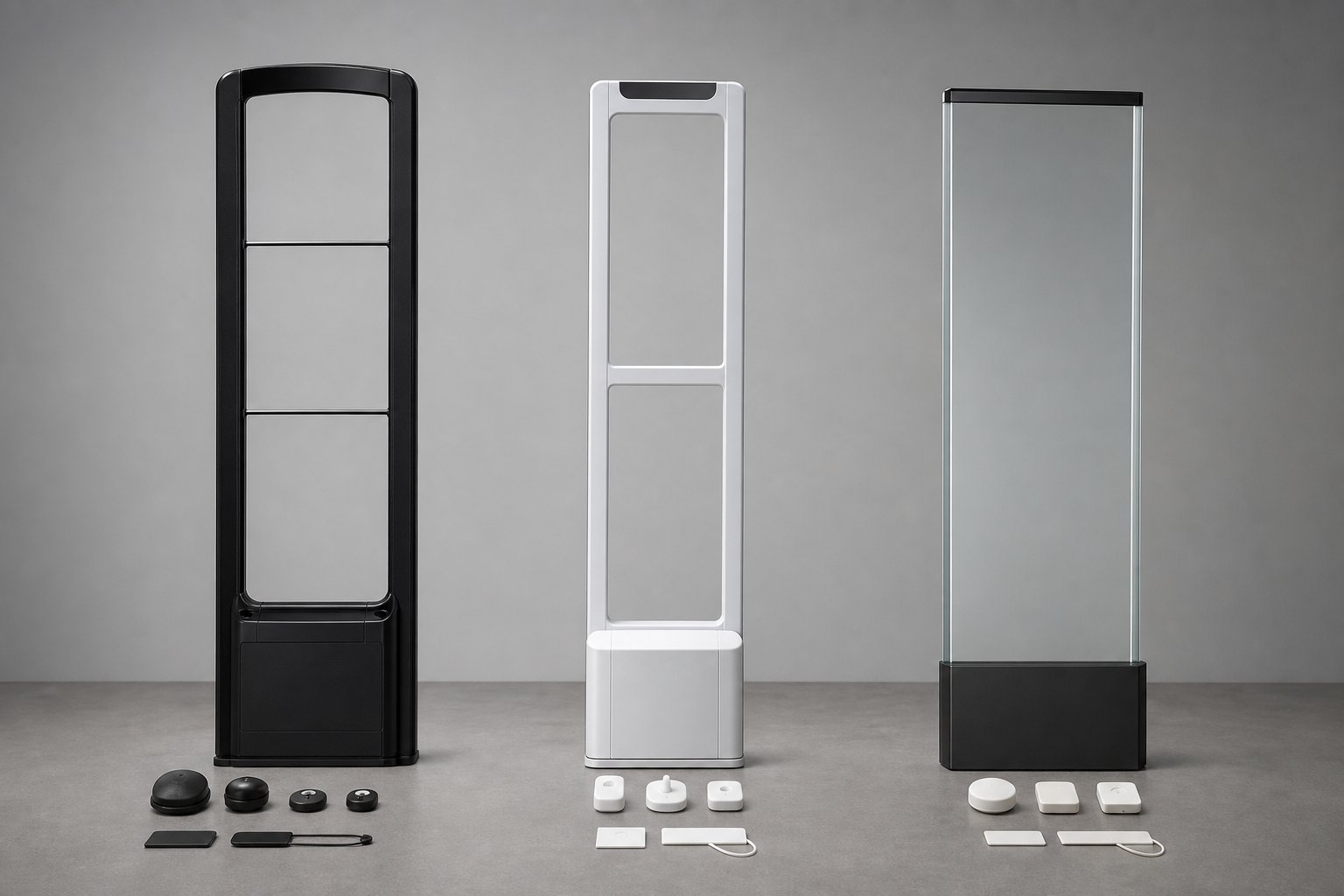
A retail EAS system has three parts: the gate (the pedestals at the entrance), the tag or label applied to the product, and the deactivator or detacher that sits at the till. When a customer pays, the cashier deactivates the label or releases the hard tag with a magnetic detacher. If an item passes through the gate without that step, the alarm and warning light trigger. That's all there is to it.
AM technology (acousto-magnetic, 58 kHz)
AM operates at 58 kHz and, thanks to its strong resistance to interference, is the standard choice for pharmacies. The reason is simple: pharmacies are full of foil blister packs, metal ointment tubes, aerosol cans and liquids — precisely the things that throw off more sensitive technologies. AM also covers a wider aisle, which suits the broad entrances of larger pharmacies.
RF technology (radio frequency, 8.2 MHz)
RF costs less up front and its paper labels are cheaper to run; however, error rates climb near metal and liquids. For a small pharmacy with a narrow doorway that mainly needs to protect non-metallic health and beauty lines, it is a perfectly sensible budget option.
| Criterion | AM (58 kHz) | RF (8.2 MHz) |
|---|---|---|
| Coverage width per aisle | Up to roughly 1.8 m | Up to roughly 1.2 m |
| Tolerance of foil and metal | High | Moderate |
| False alarm rate | Low | Moderate |
| Consumable label cost | Higher | Lower |
| Best suited to | Large pharmacies, 24-hour and superstore formats | Small neighbourhood pharmacies |
Vista Gate carries both families, and we normally base the final recommendation on your entrance width, the dominant materials in your product mix, and your annual consumables budget.
Which pharmacy products carry the highest theft risk?
Tagging every single item is neither necessary nor economical. The working rule: roughly 15 to 20 percent of your SKUs account for more than 80 percent of shrinkage. The list below is a good place to start:
| Product category | Examples | Recommended approach |
|---|---|---|
| Infant formula and baby nutrition | Branded formula tins | Soft label on the body + shelving in direct line of sight |
| Cosmetics and skincare | Serums, sunscreens, anti-wrinkle creams | Soft label inside the box or an adhesive tag |
| Sports supplements and vitamins | Protein, omega-3, multivitamins | Soft label on the tub lid |
| Small medical devices | Glucose meters, blood pressure monitors, test strips | Hard tag or clear safer box |
| Premium hair care | Hair masks and ampoules | Soft label |
| Fragrance | Glass bottles | Safer box or lanyard tag |
For small, expensive items such as glucose meters, a clear anti-theft safer box is an excellent combination: the customer can see the product and its packaging in full and pick it up freely, but cannot walk it through the gate without the box being opened at the till. That is what "protection without friction" looks like in practice.
Choosing the right tags and labels for pharmaceutical packaging
Medicine and supplement packaging is not like clothing — you can't push a pin through it. You have three practical options:
- Adhesive soft labels: the most common choice in pharmacies. They stick to the cellophane wrap, the tub body or the underside of the carton, and are neutralised at the till with a deactivator. The "dummy" version is printed onto the barcode label and stays completely invisible.
- Lanyard or cable hard tags: for bulkier packs and items with no cellophane wrap; released at the till with a magnetic detacher and reused indefinitely, so there is no consumable cost.
- Safer boxes and protective cases: for medical devices, fragrance and anything above a set price threshold.
One important practical note: place the label on the underside of the pack, or somewhere it won't cover the drug information, expiry date or barcode. It is the correct approach from a compliance standpoint, and it keeps scanning and receipt printing on your thermal printer running without interruption. You can find barcode scanners, receipt printers and EAS supplies together at vista-eas.com so your whole checkout line stays consistent.
Gate placement: where most projects go wrong
A good gate that has been badly installed is worse than no gate at all — you've spent the money and irritated your customers. The placement rules for a pharmacy:
- Keep at least 1 metre between the gate and the till, so tagged items sitting on the counter don't set off nuisance alarms.
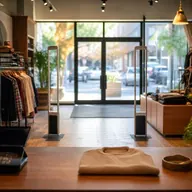
- Install the gate right in the doorway and perpendicular to the flow of traffic — not tucked into a wall corner.
- Avoid placing metal display cases, pharmaceutical fridges or air-conditioning units within 1 metre of the pedestals.
- Power the gate from a dedicated circuit with proper earthing; electrical noise is the single most common cause of unexplained alarms overnight.
- For entrances wider than 3 metres, use three pedestals (two aisles). Stretching a single aisle to the limit of its range means sacrificing sensitivity.
- Move bins and small display units away from the gate — they're a favourite hiding place for tags that have been pulled off.
Protection without friction: technical setup and staff protocol
a) Technical setup to minimise false alarms
A realistic target is a false alarm rate below 1 percent of all exits. To get there: calibrate gate sensitivity after installation using your actual products, not in an empty room; put the deactivator in the most accessible spot at the till so the cashier doesn't skip it when things get busy; and set the alarm to a soft tone paired with a flashing light. In a pharmacy, a visual alert is usually more effective — and far more dignified — than a loud siren.
b) The response protocol matters more than the hardware
Give your team one fixed, courteous line to use, such as: "Sorry about that — one of the labels probably wasn't removed. Let me check it quickly for you." Never use the word theft, never search a customer's bag, and finish the check right there beside the gate in a matter of seconds. Training your team on this protocol is the difference between a professional pharmacy and one that argues with its customers. Across our installations, the gate's mere presence does most of the work long before any alarm sounds; when an opportunistic thief sees the pedestals, they don't head for the beauty aisle.
The complete pharmacy setup: beyond the gate
The gate is the backbone, but on its own it isn't enough. A typical package for a mid-sized pharmacy looks like this:
- One dual-pedestal AM gate set for the entrance
- Soft labels for health, beauty and supplement lines (annual consumable)
- A few dozen hard tags plus one magnetic detacher
- A countertop deactivator at the till
- Two to four CCTV cameras covering the beauty aisle, the till, the entrance and the stockroom
- A barcode scanner and thermal printer to close the sales loop
When you calculate return on investment, don't measure it against sales — measure it against losses. If a pharmacy is losing the equivalent of a few formula tins and a few facial serums every month, a gate set typically pays for itself within a few months, and everything after that is straight profit. Vista Gate's specialists will run that calculation for you free of charge, based on your own product mix.
Next step: free consultation and site survey
If you want to know whether your pharmacy needs an AM or RF gate, how many aisles you need, which products should be labelled and what the final cost looks like, talk to the Vista Gate team today. Just send us your entrance width, floor area and a photo of the doorway, and we'll come back with a technical recommendation and an exact price. To browse gates, tags, labels, safer boxes and retail equipment, visit vista-eas.com — installation, staff training and the equipment warranty are on us. Secure your pharmacy shelves without making a single customer feel uncomfortable.