Retail Security Tags vs Labels: Which Suits Supermarkets?
Every supermarket chain or big-box store that reaches the point of buying a retail security system hits the same fork in the road: should products be protected with EAS labels or with hard tags? The question sounds simple, but getting it wrong either multiplies your monthly consumables bill several times over, or leaves those expensive entrance gates catching essentially nothing. Drawing on real installations in supermarkets and hypermarkets across Iran, this article spells out exactly where each option earns its keep.
How does a supermarket anti-theft system work?
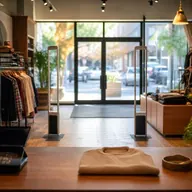
A retail anti-theft system, also known as EAS, has three parts: the security gates at the entrance and exit, the product protection (a label or a tag) on the merchandise, and the deactivator or detacher at the checkout. When a customer pays, the cashier either deactivates the label with a deactivation pad or removes the tag with a detacher. If an item passes between the gates without that step, the alarm sounds.
Supermarkets and hypermarkets typically run AM technology at 58 kHz, because it holds up far better in busy environments full of commercial refrigerators, aluminium foil and metal shelving, and it covers a wider aisle. RF technology at 8.2 MHz is cheaper and better suited to apparel and smaller shops. Choosing the technology is the first decision to make, before you pick labels or tags, because an AM label will not register on an RF gate at all.
What is an EAS label, and which products suit it?
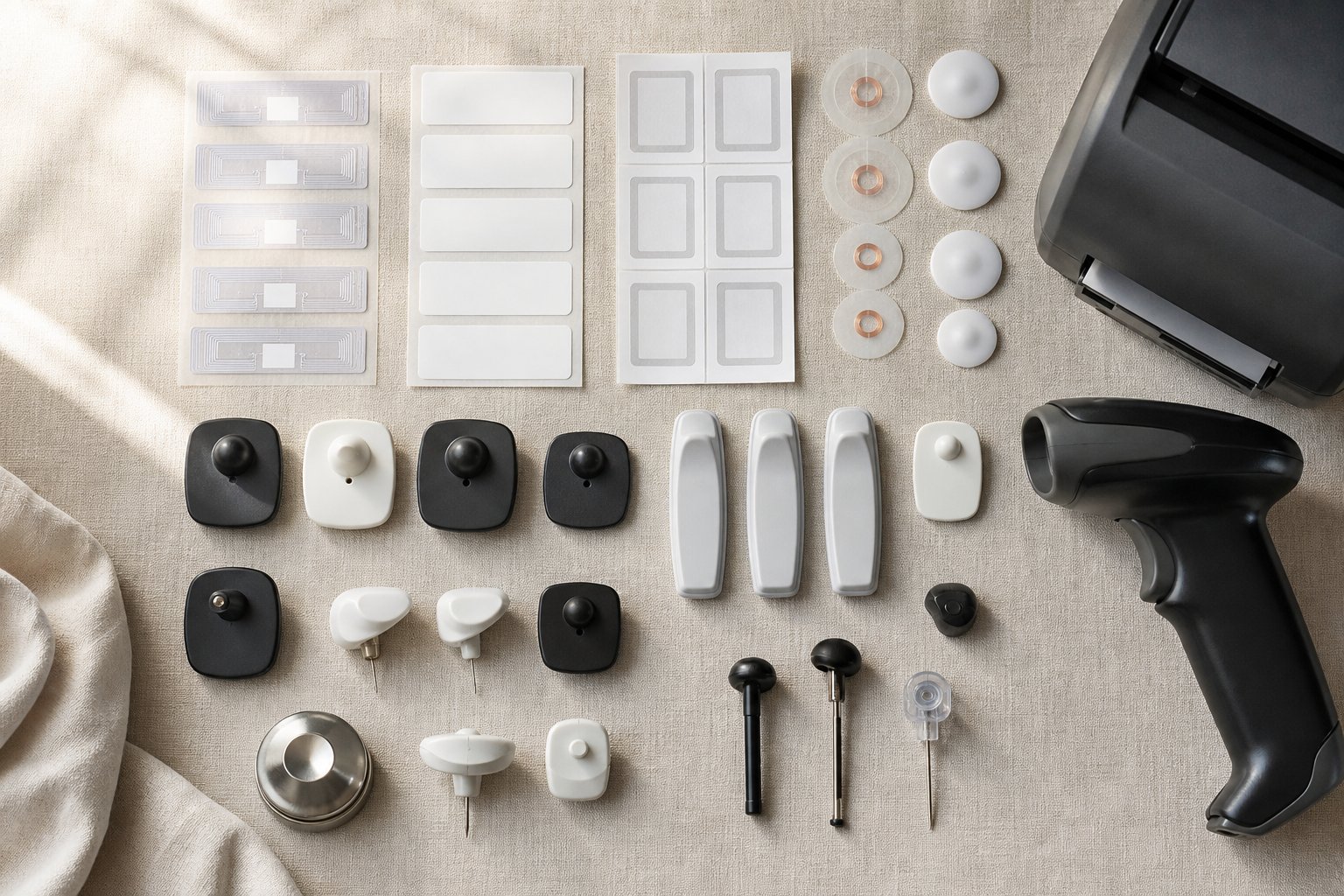
An EAS label is a thin, single-use sticker applied directly to the product packaging. It is roughly one to two millimetres thick and comes in common sizes such as 40x40 mm or 10x45 mm strips. Some versions carry a printed barcode on the surface so the shelf still looks tidy.
The key characteristic of a label is that it never comes back. The cashier simply passes the pack over the deactivation pad and the item leaves the store with the label still on it. That means a very fast checkout cycle with no complicated staff training, which is a serious advantage in a hypermarket with long queues.
Labels are the best choice for these categories:
- Packaged food, canned goods, coffee, chocolate and packaged nuts
- Cosmetics and personal care such as creams, fragrances, mascara and razor blades
- Medication and supplements in pharmacy chains
- Batteries, light bulbs, small tools and stationery
- CDs, phone accessories and blister packs
The limitations are equally clear: performance drops sharply on metal surfaces, aluminium foil and wet or crumpled plastic packaging, and a determined shoplifter can peel a label off or shield it with a foil-lined bag. That is why hypermarkets usually hide labels underneath packaging or inside the box. A full range of AM and RF labels with high-tack adhesive is available at vista-eas.com in packs of 1,000.
What is a hard tag, and where does it pay off?
A hard tag is a rigid, reusable plastic protector attached to the product with a metal pin and released only by a magnetic detacher at the checkout. Unlike a label, a tag is not deactivated; it is removed and goes straight back onto the next item.
In supermarkets and hypermarkets, hard tags are used for goods that are either high-value or packaged in a way labels cannot handle:
- Bottle tags: for spirits, premium olive oil, imported sauces and glass bottles, locking around the neck of the bottle
- Lanyard or cable tags: for large boxes, small appliances, chargers and tools
- Safers and safe boxes: for razor blades, infant formula, sports supplements and small expensive items that top every shrink report
- Apparel tags: for the clothing and hosiery sections of larger hypermarkets
A hard tag delivers far stronger visual deterrence; a shopper spots it from several metres away and the thought of stealing never gets off the ground. The trade-off is that it needs staff time to fit and remove, and when the checkout queue is long, it adds a few seconds to every transaction.
Labels vs hard tags in a retail security system
| Criterion | EAS label | Hard tag |
|---|---|---|
| Reusable | Single use | Reusable many times |
| Cost per unit | Very low | Higher, but amortised |
| Long-term cost | Ongoing consumable spend | One-off capital spend |
| Checkout speed | Very fast | Needs a detacher and a few seconds |
| Visual deterrence | Low | Very high |
| Best for | Fast-moving, lower-priced goods | Expensive, high-risk goods |
| Damage to product | None | The pin can pierce the packaging |
So which is it, labels or tags? The honest answer: both
In practice, no serious hypermarket picks just one. The right approach is a layered protection policy driven by product value and your own shrink figures.
The three-tier rule
- Tier one, fast-moving items under 500,000 toman: AM labels. The per-unit cost is negligible and checkout speed stays intact.
- Tier two, items between 500,000 and 3 million toman: hard tags or bottle tags. Volumes are limited, so recovering and reusing the tag makes economic sense.
- Tier three, items above 3 million toman or with a high theft rate: a clear safer or a locked display case, backed by a CCTV camera trained on that shelf.
The 80-20 rule in supermarkets
Experience shows that roughly 80 percent of the value stolen from a supermarket comes from about 20 percent of the range: razor blades, infant formula, supplements, fragrances, batteries and imported coffee. Before placing a bulk order, pull a week of shrink data, protect that 20 percent with tags or safers, and label the rest. That single decision can cut your annual consumables bill by up to half.
Matching the security gate to your choice
Every label and tag needs the right gate behind it. If your hypermarket entrance is wider than 1.8 metres, an AM gate with multiple antennas is the more sensible pick, because it offers greater detection range and shrugs off interference from refrigerators and motorised doors. For wider openings, add a centre pedestal so no blind spot is left uncovered.
The other factor is where the checkout sits relative to the gate. If the deactivation pad is less than two metres from the gate, false alarms become far more likely. Acrylic, metal and glass gate models, along with a placement guide, can be compared at vista-eas.com, and our specialists will recommend the right model based on your entrance layout.
Five common mistakes that render the system useless
- Mixing incompatible technologies: buying RF labels for an AM gate. Always confirm your gate frequency before ordering labels.
- Incomplete deactivation: a worn deactivation pad or insufficient power triggers false alarms on paying customers and destroys their trust.
- Sticking labels on foil: on aluminium packaging the label is effectively invisible to the gate. Apply it to card or another non-metallic surface.
- Pinning a tag through a seam: the pin should pass through a reinforced area so the garment is not damaged and the tag cannot be pulled off easily.
- Not training the cashiers: the best gate in the world is useless if the cashier ignores the alarm. Write down a clear protocol for responding to an alarm.
Cost and return on investment
In a mid-sized supermarket, shrink from theft typically runs between 1 and 3 percent of sales. If monthly turnover is one billion toman, that is a direct loss of ten to thirty million toman every month. A complete set including gates, deactivator, detacher and a starter supply of labels and tags usually pays for itself within two to four months purely from the reduction in shrink.
For a sharper estimate, note down the number of entrances, the width of each one, how many high-risk lines you carry and your average daily transaction count. Those few numbers are enough to get a realistic technical and pricing proposal rather than a generic shopping list.
Free consultation for your store
If you are still unsure whether your shelves call for labels or tags, there is no need to guess. The specialists at Vista Gate review your entrance layout, your product mix and your shrink figures, then recommend the exact combination of gates, labels, tags and safers, with site visits and installation available nationwide. Fill in the consultation form at vista-eas.com today or call our sales team so you make the right call before you order.