Perfume Store Security Gates: Complete Anti-Theft Guide
A perfume and cologne store is one of the hardest retail spaces in the world to keep secure. Your product is small, light, fits in a coat pocket, and can still carry a price tag of several hundred dollars per unit. A 100 ml bottle of an original designer fragrance disappears inside a closed hand and is worth roughly what a smartphone is worth. That is why installing a retail security system for a perfume store is no longer a luxury line item; it is a straight economic decision that pays for itself within months.
This guide walks through exactly how theft happens in fragrance retail, which security gate technology suits small high-value goods, which tags and labels actually hold on a glass bottle, and how to lay out your floor so a shoplifter never gets the opening they are looking for.
Why perfume stores are the first stop for professional shoplifters
Contrary to what many retailers assume, fragrance theft is mostly not the work of casual opportunists. Organized crews target this category because the value-to-volume ratio is unmatched. A few clear reasons:
- Extremely high value per cubic inch: An ordinary handbag holds 15 to 20 designer bottles. That is thousands of dollars of stock in a single grab.
- An easy resale market: Original fragrance needs no serial number, registration, or warranty card. It moves fast on social marketplaces and secondhand sites.
- Open displays and testers: The category demands that customers pick up the bottle, spray it, and smell it. That hands-on moment is the thief's golden window.
- Peak-hour crowds: On weekends and holidays your staff is juggling several customers at once and visual supervision effectively disappears.
- Packaging that opens in seconds: The thief ditches the cellophane and the box beside the shelf and walks out with the bottle alone. The shortage surfaces days later.
The painful part is that in most stores, this theft is invisible until the quarterly stock count. By then the evidence is long gone and the same pattern has repeated a dozen times.
Choosing the technology: AM or RF for a fragrance store?
Two technologies dominate the anti-theft gate market: AM (acousto-magnetic, 58 kHz) and RF (radio frequency, 8.2 MHz). The choice matters more than usual here, because your products are glass, often trimmed with metal, and full of liquid, and all of that affects how the system performs.
| Criteria | AM gate (58 kHz) | RF gate (8.2 MHz) |
|---|---|---|
| Coverage width per aisle | Up to about 8.8 ft (270 cm) | Around 5 to 6 ft (150-180 cm) |
| Sensitivity to liquid and metal | Low - very stable | High - detection range can drop |
| False alarm rate | Low | Moderate |
| Hard tag selection | Very wide | Wide |
| Upfront cost | Higher | More budget-friendly |
| Best suited to | Fragrance, jewelry, cosmetics, hypermarkets | Apparel, bags and footwear |
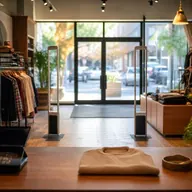
The straight answer: for a perfume and cologne store, AM is the first choice. The reason is simple. The liquid inside the bottle and the metal layers on the cap can weaken an RF signal enough that the tag is missed at the exact moment it passes through the gate. AM is far more resistant to that interference, and it covers the wide entrances typical of mall storefronts. The acrylic and glass AM models at vista-eas.com are an excellent fit for premium stores that do not want hardware ruining the look of the entrance.
If your entrance is wide or fully glazed
Plenty of fragrance shops sit in malls behind a full-glass storefront with a 10 to 16 ft opening. In that case you either run a multi-panel system (one center panel splitting the opening into two lanes) or go with in-floor gates concealed beneath the tile. A recessed floor installation keeps the entrance completely clean and is the best answer for brand stores that care about their interior design.
Tags and labels made for glass bottles: the heart of the system
Without the right tag, a gate is just expensive decor. The real challenge in this category is the round, slippery surface of a fragrance bottle and the cellophane-wrapped box. Your practical options:
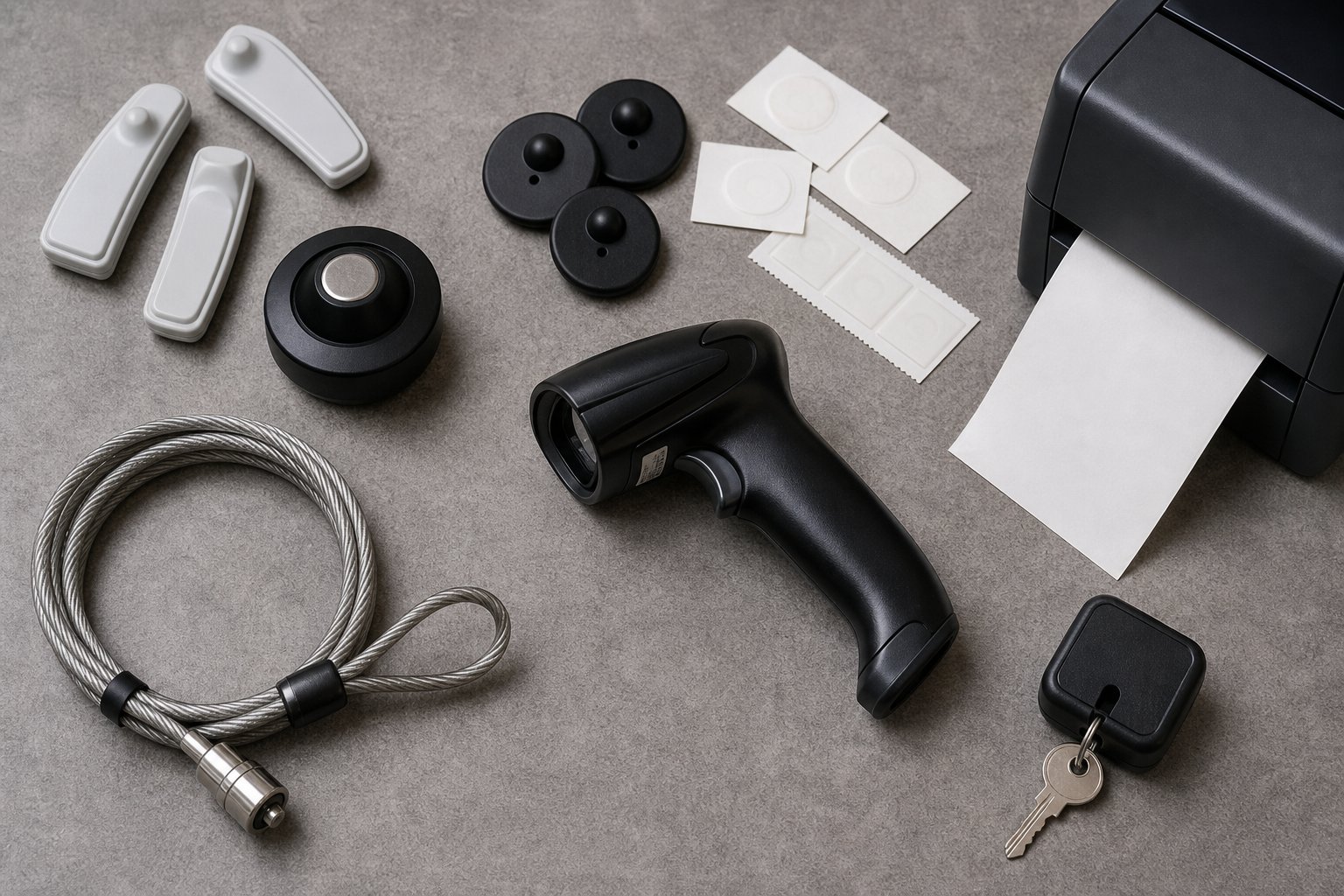
- AM soft label on the box: The cheapest route and fine for high-volume lines. But if it sits on the cellophane, the thief tears the wrap off and the label goes with it. The fix: place the label under the cellophane or inside the box.
- Lanyard hard tag: A steel cable loops around the bottle neck or through the box handle and locks with a magnetic mechanism. The best option for anything in the premium price bracket.
- Bottle tag: A collar that locks around the neck of the bottle and will not release without the dedicated detacher magnet. Ideal for cylindrical bottles.
- Clear safer box: A lockable polycarbonate case that holds the entire fragrance package. The customer sees the product in full but cannot open it. Unbeatable for self-service shelving.
- Pull box tethers: For counter testers that have to stay reachable but must never leave the counter.
One simple rule for this category: anything above a set price threshold gets a hard tag, not a soft label. Pick the threshold yourself - say, anything over $100. The full range of hard tags, bottle tags and safer boxes is available at vista-eas.com, and our specialists will recommend the right model based on how your brands are actually packaged.
CCTV and the blind spots in a fragrance store
The gate stops merchandise from leaving. The camera gathers evidence and records behavior. The two complement each other; neither replaces the other. In a perfume store, a handful of camera positions are critical:
- A face-capture camera at the entrance: Mounted at roughly 160-170 cm (about 5.5 ft) so you record faces, not the tops of heads.
- A camera over the register: Both for transaction oversight and to record the moment a tag is removed.
- A camera facing the premium shelves: Angled so the customer's hands and the shelf are both in frame at the same time.
- Coverage behind columns and in corners: A professional finds the blind spot first and picks up the product second.
Keep at least 15 days of recorded footage. Most shortages are discovered late, and with a 3-day archive there is effectively no evidence left to review.
Layout and store rules that make theft difficult
Equipment is half the job. The other half is store discipline. Put these in place:
- Keep the most expensive brands in a locked display behind the counter or in the seller's direct line of sight, never near the exit door.
- Give the shelf closest to the door to low-value items: gift boxes, body sprays, accessories.
- Set shelf heights so the sightline from behind the register runs clear to the back wall.
- For testers, keep only the tester bottle on the counter, on a pull-box tether. A full carton should never sit open on the counter.
- Have a defined alarm protocol: politely, without any direct accusation, ask the customer to walk back through the gate.
- Do a quick nightly count of high-value items so shortages surface the same day rather than at the quarterly inventory.
System cost versus theft losses: running the ROI
Let us do the math honestly. Say your store loses just 4 bottles a month at an average price of $150. That is $600 a month and $7,200 a year walking out the door. A complete set - an AM gate, a batch of hard tags and a few safer boxes - costs a fraction of that annual loss.
| Item | Role in the system | Priority |
|---|---|---|
| Dual-panel AM gate | Controls the exit of tagged merchandise | Essential |
| Bottle / lanyard hard tags | Protects high-value items | Essential |
| AM soft labels | Covers mid-range items | Important |
| Detacher | Fast tag removal at the register | Essential |
| Clear safer box | Self-service shelving | Important |
| CCTV | Evidence capture and review | Important |
| Display locks and holders | Complementary physical layer | Supplementary |
One important point: once the system is installed, the deterrent effect is itself part of the return. A gate at the door and a tag on the bottle send an unmistakable message, and the thief moves on to the next store. Retailers who roll the system out fully and run it consistently typically see the bulk of their shrinkage disappear within the first few months.
Common mistakes when installing perfume store security
These are the errors we run into again and again on site visits:
- Buying a cheap gate with no support: A gate with no sensitivity tuning and no periodic service will, within a few months, either alarm at nothing or stop reading altogether.
- Installing next to a source of interference: Too close to an electrical panel, a roller-shutter motor or an LED display, and the system becomes unstable.
- Sticking labels on the cellophane: The single most pointless step you can take - the wrap comes off in a second.
- Forgetting to remove tags at checkout: A paying customer sets off the alarm on the way out and the whole shopping experience is ruined. The detacher must always be at the register and in working order.
- Tagging only some products: Once a thief works out that only certain brands are tagged, they simply take the rest. Coverage has to be uniform.
- Switching the system off during busy hours: Which is precisely the hour when most theft happens.
Summary and free consultation
Protecting a perfume and cologne store is never a single-product fix. It is a combination: an AM gate sized to your entrance, hard tags on the expensive stock, labels on the mid-range, safer boxes for open shelving, cameras in the right places, and daily discipline from the sales team. Once those layers stack up, theft goes from a daily risk to a rare event.
The specialists at Vista Gate, with years of experience equipping fragrance, jewelry and cosmetics retailers, can look at your floor area, entrance width and product packaging and tell you exactly which system you need - and what you can skip. For a free consultation, a site survey, or a quote on gates, tags and safer boxes, call us now or submit a request through vista-eas.com and we will get back to you quickly.