
Sports Store Security Gates: Apparel to Bulky Gear
A sports store is one of the hardest spaces to secure. Under a single roof you have thin lightweight T-shirts, boxed sneakers, small and expensive smartwatches, and heavy steel dumbbells and treadmills. Each of these behaves differently around a retail security system, and if you apply one blanket solution to all of them, either the merchandise stays unprotected or the gate alarms so often for no reason that you end up switching it off yourself after two weeks. This article spells out exactly what equipment each product category in a sports store actually needs.
Why sports stores are more exposed to theft than other retailers
The sheer range of products in a sports store is both its biggest sales strength and its security Achilles' heel. Three factors make this sector an attractive target for thieves:
- High value-to-size ratio: sports sunglasses, smartwatches, branded gloves, wristbands and supplements all fit in a pocket, yet any one of them can be worth more than a full day's takings.
- Customers are meant to touch and try: in a sports store the customer has to put the shoe on, hold the racket, feel the weight of the dumbbell. That legitimate handling is exactly what creates the chance to peel off a label or conceal an item.
- Seasonal peaks: early autumn, sale days and the holiday rush pack the floor so tightly that human supervision effectively stops working.
Across the projects we've installed, shrinkage in sports stores typically runs between 1% and 3% of annual sales. For a store turning over 500 million toman a month, that means 60 to 180 million toman a year quietly coming off the bottom line — usually several times the cost of a complete loss-prevention system.
AM or RF security gates: which suits a sports store better?
Two main technologies dominate the market: AM (acousto-magnetic, 58 kHz) and RF (radio frequency, 8.2 MHz). The choice between them matters more in a sports store than in almost any other retail setting, because there's so much metal on the floor.
| Criterion | AM gate | RF gate |
|---|---|---|
| Coverage width per aisle | Up to around 180 cm | Up to around 120 cm |
| Tolerance of metal and noise | Very high | Moderate |
| False alarm rate | Low | Higher |
| Consumable label cost | Higher | More economical |
| Best suited to | Sports stores with metal equipment and wide entrances | Small sports boutiques selling apparel only |
What we recommend for sports stores
If your floor holds dumbbells, barbells, steel shelving, gym machines or bicycles, an AM gate is the right call. RF is far more sensitive to metal mass and electrical noise, and in that kind of environment it throws a lot of false alarms. If, on the other hand, you sell only apparel and footwear and your entrance is under 120 cm wide, RF comes with lower setup and consumable costs. The specialists at vista-eas.com normally review your floor plan and entrance width before recommending a model, so the number of aisles and the gate type are matched to your store.
Protecting activewear: hard tags, pins and lanyards
Activewear isn't like ordinary clothing. Technical fabrics such as Lycra, spandex, mesh and waterproof shells get punctured by a standard pin, and the hole stays visible — something customers spot immediately and complain about.
Choosing the right tag for each fabric
- Cotton T-shirts and shorts: a standard hard tag (shell or square) with a 15 mm pin, fitted through a side seam or a hemmed edge.
- Stretch, swim and waterproof garments: always use a lanyard tag (cable tag). The cable threads through a buttonhole, a size-label loop or a drawstring channel, so the fabric is never pierced.
- Expensive jackets and hoodies: a larger hard tag with a strong magnetic lock (12,000 gauss and above) so it can't be opened with a homemade magnet.
- Socks, laces, wristbands and packaged items: a soft label stuck on the packaging — the cheapest and fastest option.
One practical rule: always fit the tag where forcing it off would make the garment unsellable. A tag on an unimportant corner of a garment is just decoration.
Athletic footwear: the problem with pairs and boxes
Trainers are one of the most stolen items in this sector, because they're expensive and they can simply walk out of the store on someone's feet. Three approaches work well:
- Lanyard tag through a lace eyelet: fast, damage-free and reusable. The best option for display pairs.
- AM label inside the box, under the lid: for boxed stock; the thief has no idea where the label is.
- Splitting the pair: old-school but still effective — right shoe on display, left shoe in the stockroom.
Watch out for insoles and foil packaging
Some shoe boxes and inner bags are lined with aluminium foil. That lining is exactly the material professional shoplifters use in booster bags, and it can block a label's signal completely. Always fit the label outside any foil lining, on a plain cardboard surface.
Bulky equipment: dumbbells, barbells, treadmills and bikes
Plenty of retailers assume heavy goods don't need protecting. In reality, theft of these items just takes a different shape: pushing them toward the exit during a busy spell, removing accessories (pedals, saddles, weight plates, charging cables), or swapping the price label.
- Long cable tags: a 30 to 100 cm steel cable looped around a bike frame, a treadmill handrail or a barbell, released only by the magnetic detacher at the till.
- Labels on non-metal packaging: for boxed plates and dumbbells, stick the label on the cardboard, at least 5 cm away from any metal surface, so read range doesn't drop.
- Cable locks and security stands for display units: the same family of laptop locks used in electronics stores works just as well for a treadmill's console tablet or watches on display.
- A CCTV camera covering the goods-in door: most bulky-item losses happen at the back door during deliveries, not at the front entrance.
Small, high-risk items: supplements, smartwatches and eyewear
This category has the smallest footprint and the highest margin — which is precisely why it's the first target. Three layers are recommended:
- Safer boxes: a clear lockable case that keeps the product visible but inaccessible; ideal for premium supplements, smartwatches and sports headphones.
- AM labels on supplement tubs: cheap and quick, especially for large protein and creatine containers.
- A locked display case near the till: never leave anything above a set price threshold on open display.
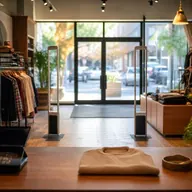
Store layout and correct gate positioning
Even the best gate won't work if it's badly installed. The installation details that make the biggest difference in sports store projects:
- Distance from metal and roller shutters: keep at least 50 cm between the gate pedestal and any metal door, shutter or heavy steel shelving.
- A dedicated power circuit: don't plug the gate into a socket shared with a fridge, air conditioner or shutter motor; mains noise is the number one cause of false alarms.
- Till-to-gate distance: at least 1 metre. The detacher on the counter generates a strong magnetic field, and placing it near the gate confuses the system.
- A forced exit route: arrange the fixtures so there's no side route out that bypasses the gate.
- Fitting rooms in direct line of sight: never put fitting rooms at the end of a blind aisle; the door needs to be visible from the sales counter.
Layering it up: gates, cameras, barcodes and the till
A loss-prevention system only really delivers when it's connected to the sales process. That means a barcode scanner at the till recording every item accurately, a thermal receipt printer issuing a valid receipt, and CCTV cameras over the till and entrance covering both customer theft and internal error. A widely accepted figure across global retail is that roughly one third of shrinkage is internal, not customer-driven. vista-eas.com supplies this full kit in one place, so you don't have to source each piece from a different vendor and then discover your tags and gates don't work together.
Cost, maintenance and payback
A typical sports store installation usually includes:
- One or two AM gate aisles, sized to the entrance width
- 500 to 2,000 hard tags and lanyard tags for apparel and footwear
- One roll of labels for packaged goods and supplements
- A detacher and deactivator pad for the till
- A handful of cable tags for bulky equipment
Hard tags aren't consumables — they're reused indefinitely; only labels are an ongoing cost. If the system prevents even 5 to 10 million toman of stock loss a month, the upfront investment typically pays for itself in 3 to 6 months. Maintenance is straightforward too: a quarterly function test with a test tag, a check of the pedestal connections, and a clean of the till detacher.
Summing up, and your next step
A sports store won't be solved by a single-layer setup. AM gates at the entrance, lanyard tags for technical apparel and footwear, labels for packaged goods, cable tags for bulky equipment and safer boxes for small high-value items — that combination is what brings shrinkage down to an acceptable number.
If you want to know exactly what your store needs, and in what quantity, for your floor area, entrance width and product mix, talk to the specialists at Vista Gate today. Send over your floor plan, or even a few photos of the entrance, and we'll prepare a free gate layout, the right tag type for each product category and an accurate cost estimate. You can also browse and compare the full range of gates, tags, barcode scanners and cameras at vista-eas.com.