
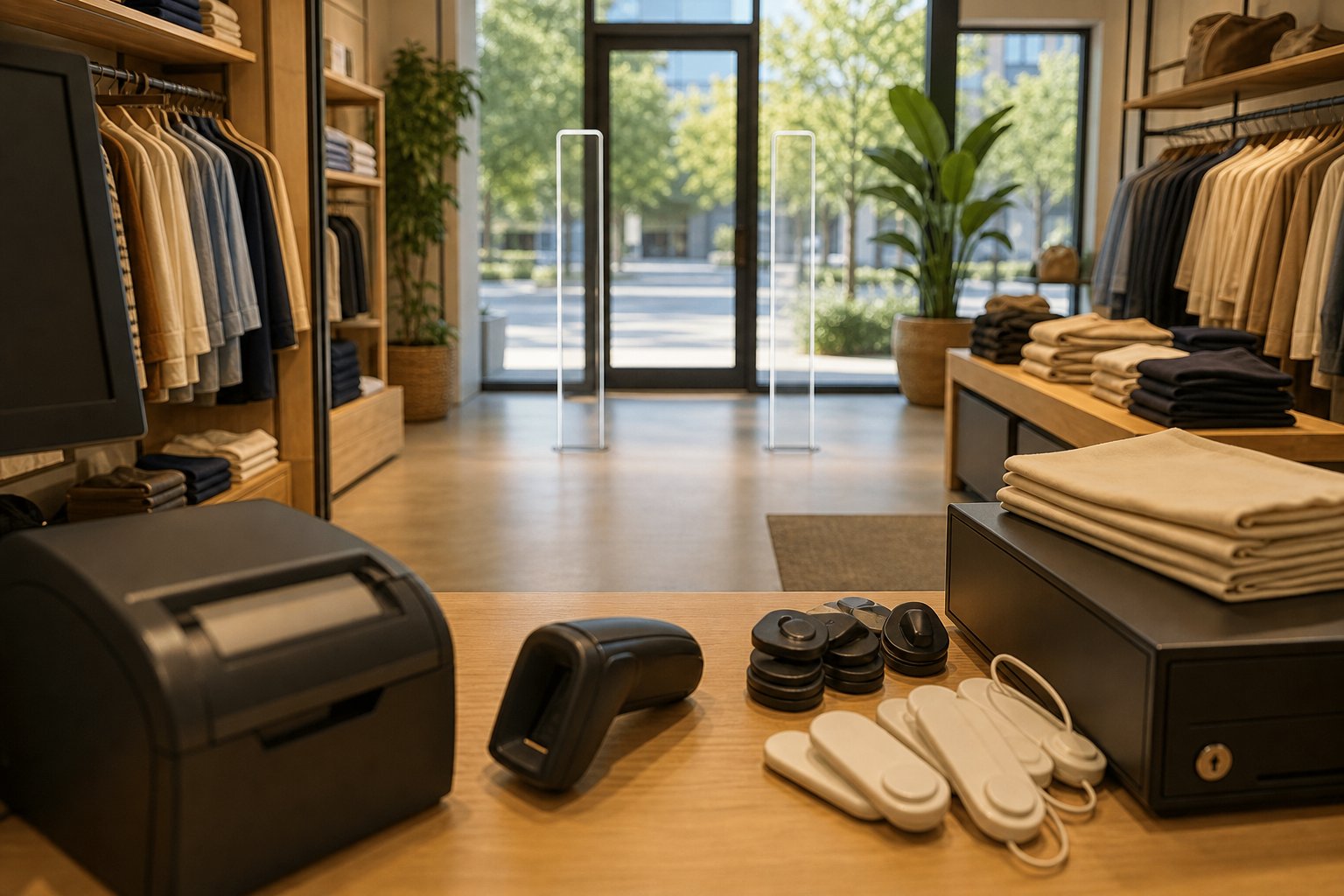
Retail Security Gates for Bag & Shoe Stores: Best Tags
To a professional shoplifter, a bag and shoe store is one of the most attractive targets on the high street. The merchandise is light, the value per item is high, there is no packaging, customers pick it up to try it on, and in the fitting room or over by the shoe bench it slips out of the salesperson's line of sight. That is why installing a retail security system for a bag and shoe store is not a luxury expense in this trade — it is part of your working capital. But our experience at Vista Gate shows that most retailers in this sector buy the right gate and then fit the wrong tag; and that is exactly where the theft happens and where expensive leather goods get ruined.
This article answers the core question head-on: which security tag suits leather bags and shoes, which tags damage leather, and which combination of gate and tag delivers the strongest deterrent with the least harm to your stock.
Why are bag and shoe stores more exposed to theft than other retailers?
Theft in bag and shoe stores follows a clear pattern. Unlike a supermarket, where losses are small and scattered, here a single incident can wipe out several days of profit. The main risk factors are:
- High value per item: A single genuine leather handbag or one pair of leather boots can be worth several million Toman on its own.
- Trying the product on is part of the buying process: The customer has to slip the shoe on and sling the bag over a shoulder — which means the item inevitably leaves the shelf.
- Plenty of blind spots: Fitting rooms, the space behind tall shoe stands and the narrow aisles between displays all block the salesperson's view.
- Easy to conceal: A small purse or a pair of sandals slips easily into a larger bag, a stroller, or even another shoe box. The box-inside-a-box trick is the single most common method of theft in this trade.
- Seasonal rushes: During the holidays, sales events and back-to-school season, the customer-to-staff ratio climbs sharply and keeping an eye on the floor becomes impossible.
CCTV records these incidents, but it does not stop them. What an EAS system does is put a physical and psychological barrier in place at the moment of exit.
How does a bag and shoe store security system work?
Every electronic article surveillance (EAS) system has three parts: the gates at the entrance, the tag or label on the product, and the detacher or deactivator at the checkout counter. When a live tag passes between the gates, the alarm sounds.
AM vs RF gates for this sector
Two technologies dominate the market, and the choice between them directly determines which tags you can fit to leather:
| Feature | AM gate (acousto-magnetic, 58 kHz) | RF gate (radio frequency, 8.2 MHz) |
|---|---|---|
| Detection width per aisle | Up to roughly 180 cm | Up to roughly 120 cm |
| Sensitivity to metal and moisture | Low | High |
| False alarm rate | Low | Medium to high |
| Hard tags for bags and shoes | Widely available in many styles | Available and cheaper |
| Thin adhesive labels | Slightly thicker | Very thin and low-cost |
| Upfront cost | Higher | More economical |
Practical advice: if your store has a wide entrance, a lot of metal shelving, or you sell bags with metal clasps and chains, an AM gate is the safer bet. For smaller shops with a standard doorway and a tight budget, an RF gate does the job perfectly well. Models from both families are listed in the retail gate section of vista-eas.com, with full specifications and real-world detection widths.
Which tag is right for leather? The short answer and the detailed one
Short answer: a lanyard (cable) tag or a purpose-made shoe tag — never a pin tag pushed straight through leather.
The detailed answer takes a little longer. Unlike fabric, leather has no woven fibres. When you push the pin of a clamshell tag through fabric, the threads simply move aside, and once the tag comes off the hole all but closes. Leather, though, is a continuous surface; the pin tears the fibres and the hole is there for good. On patent, high-gloss and synthetic (PU) leather the damage is even worse, because the top coat cracks and the crack keeps spreading over time.
So the golden rule is simple: never put a pin through any leather surface. Instead, use tags that pass through an existing opening on the product using a cable, a metal strap or a clip.
Types of security tag for bags and shoes, and where each one belongs
1. Lanyard tags (cable tags) — the first choice for leather bags
This tag has a rigid body locked to a coated steel cable. You thread the cable through the bag's handle, the metal ring on the strap, the zip pull or a buckle, then lock it. No hole is made, and the tag can only be removed with a magnetic detacher at the counter. Cable lengths usually run from 10 to 30 cm, which makes them ideal for handbags, weekend bags and leather backpacks.
2. Shoe tags (clip tags)
Standard shoe tags use a strap or clip threaded through a lace hole, a sandal buckle or the top edge of a boot shaft. For laceless shoes — loafers, dress shoes, flats — use a short lanyard tag with the cable running inside the shoe and around the upper. One important point: always tag the display shoe and its pair as well, because single-shoe theft is common in this trade.
3. Soft adhesive labels
Thin adhesive labels suit lower-value items such as socks, wallets, synthetic leather goods and accessories. The cost per label is tiny, and it is deactivated at the counter with a deactivator pad. But never stick an adhesive label directly onto genuine leather — the adhesive stains the dye and the finish. The right approach: stick the label on the cardboard price tag, on the label inside the shoe, or on the box.
4. In-box tagging (for shoe stores that display from stock)
If you sell out of boxes, a soft label inside the box plus a hard tag on the display shoe itself is an effective combination. It shuts down the swap-the-box-contents trick.
5. Self-alarming tags
For luxury bags and premium brands, self-alarming tags are the way to go. These sound an alarm from the product itself — when it passes through the gates, if someone tries to cut the cable, or if it leaves a defined zone. The full range of hard, lanyard and self-alarm tags is available from the Vista Gate store in both AM and RF frequencies.
Common tagging mistakes with leather bags and shoes
- Using a long pin on leather: The most frequent error of all; the result is a permanent hole and a complaint from the customer at handover.
- Tagging a decorative strap or tassel: These parts pull away with one tug, taking the tag with them.
- One tag per pair of shoes: The thief simply takes the untagged shoe and comes back later to complete the pair.
- Hiding the tag round the back of the item: A tag only works as a deterrent when it is seen. Keep it in plain view.
- Storing removed tags on the counter next to the door: Detached tags need to sit at least a metre away from the gates, or you will get nuisance alarms.
- Displaying tagged stock right in front of the gates: This triggers false alarms and teaches your staff to stop trusting the system.
Gate installation and store layout
Even the best tag is useless if the gate is installed badly. A few practical points:
- Set the spacing between the two pedestals to match the technology you chose; for doorways wider than 2 m you need a third pedestal or a wide-coverage AM model.
- Keep the gates at least 50 cm away from automatic doors, metal roller shutters and LED signage to cut down on interference.
- Power the gates from their own dedicated socket, ideally with a surge protector; voltage fluctuation is the most common cause of a failed gate board.
- Mount the detacher on the counter on the salesperson's dominant side, so tags come off quickly and no queue builds up.
- Run a simple weekly test: walk a known-good tag through the middle and both sides of the gates and confirm the alarm still fires.
Cost and return on investment
The maths is straightforward. Suppose your store loses just two leather items a month, worth 3 million Toman each; that is roughly 72 million Toman of stock walking out the door every year with nothing to show for it. A complete set — gates, detacher and a few hundred hard tags — typically pays for itself within the first few months. On top of that:
- Hard tags are reusable and last for years; you pay for them once.
- With less need to watch the floor, your staff spend more time actually selling, and conversion goes up.
- You can put higher-value stock within arm's reach of customers with confidence — and open access to merchandise directly increases sales.
Summary: your selection checklist
- Genuine leather bags → lanyard cable tag through a ring or handle
- Lace-up leather shoes → shoe tag threaded through the lace hole
- Laceless shoes → short lanyard around the upper
- Low-value synthetic leather and accessories → soft label on the price tag
- Luxury items → self-alarming tag
- Wide entrance or lots of metal → AM gate; standard doorway and limited budget → RF gate
For a precise recommendation, send the Vista Gate team a photo of your shop entrance along with a few examples of your merchandise. We will look at your doorway width, the dominant material in your range and your floor layout, and recommend the right gate and tag combination — with no upselling. For free advice, a current price list, or to arrange a site visit and installation, call our specialists now or submit your request through vista-eas.com. The capital sitting in your window display is worth protecting.