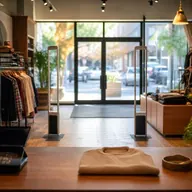

Choosing an Anti-Theft Gate for a Food Hypermarket
Food hypermarkets are one of the toughest environments to control theft in, thanks to their huge product variety, heavy customer traffic, and the sheer volume of small, high-turnover items. Choosing the right retail security gate can be the difference between a profitable store and one that bleeds inventory every single day. In this guide we walk through, step by step, which type of gate, which technology, and which tags and labels suit a food hypermarket — so you raise security without spoiling the shopping experience.
Why does a food hypermarket need a specialized security gate?
In chain stores and food hypermarkets, a large share of theft targets small but pricey items like razor blades, coffee, imported chocolate, supplements, cosmetics, and specialty drinks. These items slip easily into a pocket or bag, and keeping an eye on them by sight is nearly impossible.
A standard anti-theft gate system at the entrance and exit is your store's last line of defense. But here's the key: not every gate is built for the crowded, humid environment of a large supermarket, which is exactly why a specialized choice matters. The experts at vista-eas.com typically review your store layout and product mix before recommending a model.
- A direct cut in inventory shrinkage and a boost to profit margins
- A psychological deterrent for both professional and opportunistic thieves
- Less need for permanent security staff at the exit
- Protection for high-risk items without restricting customer access
AM or RF technology — which is better for food retail?
The most important decision when buying a gate is choosing between the two main technologies: AM (acousto-magnetic) at 58 kHz and RF (radio frequency) at 8.2 MHz. Each has its own strengths and use cases.
AM technology — the reliable choice for hypermarkets
AM systems perform more consistently in crowded spaces and around metal and liquids. Since food aisles are packed with metal cans, liquid bottles, and foil, AM technology usually triggers fewer false alarms and offers a longer detection range. For most large hypermarkets, it's the first-choice technology.
RF technology — economical for smaller spaces
RF systems have a lower upfront cost and their labels are cheaper and flat, but they're more sensitive to metal and liquids. For neighborhood supermarkets and smaller stores, they're a cost-effective option.
| Feature | AM gate | RF gate |
|---|---|---|
| Frequency | 58 kHz | 8.2 MHz |
| Stability around metal and liquid | Excellent | Moderate |
| Detection range per panel | Up to about 120 cm | Up to about 90 cm |
| Consumable label cost | Higher | Lower |
| Best for | Hypermarkets and large stores | Small and mid-size supermarkets |
If you're torn between the two technologies, the advisors at vista-eas.com will recommend the best option based on your floor area and product mix.
Aisle width and the number of gates you need
A common mistake is installing a gate with an overly wide aisle, which cuts detection accuracy. Every gate panel has a defined coverage range, and if the gap between two panels exceeds the standard range, tags simply won't be detected.
- For each exit aisle, the maximum effective width is usually between 90 and 120 cm.
- For wide hypermarket entrances, you'll need multi-aisle panels so several back-to-back lanes are covered.
- Separate the entrance from the exit; place the gate on the customer's way out so traffic isn't disrupted.
Before buying, be sure to measure the exact width of your entrance and count your checkout exits so the correct number of panels can be determined.
Choosing the right tags and labels for food retail
A gate is useless without the right tags and labels. In a food hypermarket, most items have soft or small packaging, so adhesive labels are far more practical than hard tags.
- Soft labels: for chocolate boxes, coffee, supplements, and cardboard packaging; deactivated at the checkout with a deactivator.
- Hard tags: for pricey items without suitable packaging, such as specialty beverage bottles or expensive cosmetics; removed at the checkout with a magnet.
- Foil and metal labels: for items like foil-wrapped coffee, where a regular label performs poorly.
Don't forget that alongside the gate you'll need a label deactivator installed at every checkout, so customers can walk through without an alarm after paying. You can source the complete set of tags, labels, and deactivators all in one place from vista-eas.com.
Installation tips and the store environment
A hypermarket is full of electromagnetic interference sources: industrial refrigerators, automatic doors, digital scales, and power supplies can all affect gate performance. Keep these points in mind:
- Keep the gate at least one meter away from large refrigerators and automatic glass doors.
- The installation floor shouldn't have rebar or dense metal near the surface; if needed, use a suitable surface-mount setup.
- Gate sensitivity calibration should be done by a technician to strike the balance between "false alarms" and "missed detections."
- Provide a separate power line for the gate so checkout noise doesn't interfere with it.
Cost, warranty, and after-sales service
The price of a security gate depends on the technology, the body material (acrylic, metal, or a mix), the number of panels, and the brand. But the real cost isn't just the purchase price; you also need to factor in the cost of consumable labels, installation, and long-term support.
- Pay close attention to the warranty on the electronic board and power supply; these are the two most expensive parts to repair.
- Check that a steady supply of consumable labels is available; a gate whose labels are hard to find becomes effectively useless.
- Take local installation and support seriously, so that if something breaks, your store isn't left unprotected.
Beyond selling gates, tags, and labels, Vista Gate provides installation, calibration, and ongoing support to keep your security system running at all times.
Summary and consultation
Choosing a security gate for a food hypermarket comes down to the right mix of technology (preferably AM), a panel count matched to your aisle width, tags and labels suited to your packaging, and a proper install away from interference sources. Investing in the right system pays for itself within a few months through reduced theft.
Contact the Vista Gate experts right now for a free consultation and a precise gate choice tailored to your store, or place your order through vista-eas.com. We'll review your store layout, recommend the best combination of gate, tags, and labels, and handle installation and support.