
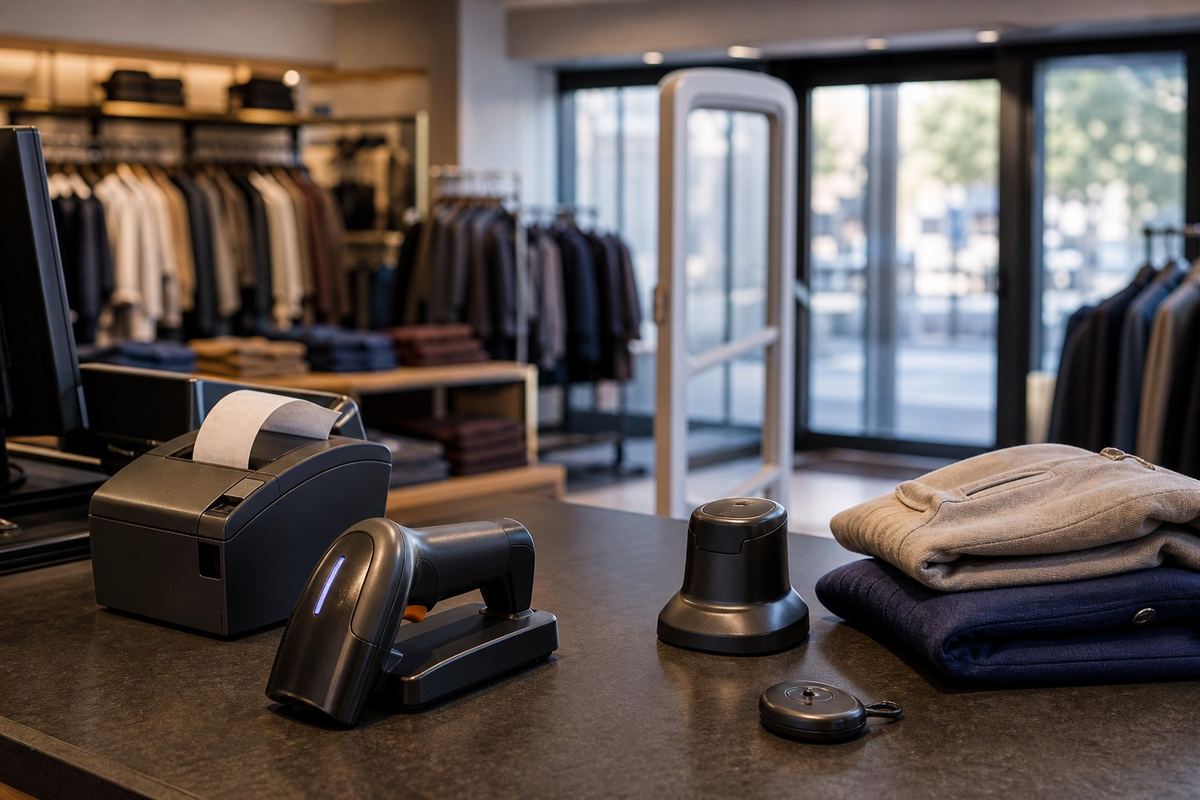
Electrical Noise and False EAS Gate Alarms in Old Malls
If your store sits in an older downtown shopping mall and your EAS gate alarms every few minutes with no customer and no tag in sight, the problem is almost never the gate itself. In more than 80 percent of the cases the Vista Gate technical team has investigated across Tehran, Mashhad, Tabriz and Shiraz, phantom alarms trace back to two things: electrical noise on the building's power supply and a faulty grounding system, or none at all. This article explains exactly why older buildings are the perfect breeding ground for these faults, how to track the noise source down in under an hour, and which fixes actually hold up in practice.
Why do EAS gates false-alarm more often in older malls?
Retail anti-theft gates, whether AM (acousto-magnetic, 58 kHz) or RF (radio frequency, around 8.2 MHz), are essentially very sensitive radio receivers. Their job is to pull an extremely weak signal, the response of a small tag or label, out of a sea of ambient electromagnetic activity. Anything that puts energy into that frequency band, or into the bands next to it, can look to the gate exactly like a tag talking back.
Now picture the buildings in malls put up in the 1980s and 1990s:
- The wiring was usually run with no ground conductor at all, just line and neutral.
- A single distribution panel is shared by dozens of units, and every unit injects its own noise back into the network.
- Power cables run without conduit or trunking, bundled side by side under the floor or above a suspended ceiling.
- Shared building services such as the elevator, escalator, chiller and boiler room sit on the same supply.
- The shared transformer and meter bank is usually mounted near the mall entrance, which is exactly where the gate goes too.
The result is that a perfectly healthy gate installed in that environment can produce a false-alarm rate tens of times higher than the identical model in a newly built shopping center.
What is electrical noise, and how does it get into an anti-theft gate?
To troubleshoot properly, you need to know which door the noise came in through. There are two main routes:
1. Conducted noise
This noise reaches the gate's control board through the mains wiring and the outlet itself. The usual culprits are switching power loads: the compressor in a display fridge, an air-conditioner motor, dimmers and cheap LED drivers, elevator inverters and industrial chargers. Every time one of these switches on or off, a voltage spike lands on the 220 V line. The classic symptom is a gate that alarms at the exact moment the AC kicks in or the elevator starts moving.
2. Radiated noise
This kind travels through the air, and the source does not have to share a circuit with the gate. Advertising monitors and TVs, ballasts in old fluorescent fixtures, scrolling LED signs, Wi-Fi routers, burglar alarms, even the gate in the store next door all belong here. In a busy mall where two RF gates on closely spaced frequencies face each other across the aisle, the two will effectively keep triggering one another.
Grounding: the prime suspect
Grounding is not just a safety requirement; for an EAS gate it is a functional component. The control board has to dump the noise collected on the chassis and on the cable shields into the earth through the ground path. With no ground, or with ground resistance that is too high, that energy has nowhere to go and lands straight in the signal receiving circuit.
A few key points that older malls routinely get wrong:
- Tying ground to neutral: the most common shortcut old-school electricians take. In practice it injects the entire building's noise directly into the gate chassis.
- Ground resistance above spec: ground resistance should be under 5 ohms; in many older malls it measures north of 20 ohms.
- A shared, bone-dry ground pit: pits that have not been watered or serviced in years simply stop doing their job.
- Ground loops: when the two gate pedestals are grounded at two different points, you form a loop that acts as a noise antenna in its own right. Both pedestals must land on one common ground point.
Common noise sources and how to spot them
| Noise source | Type | Telltale symptom | Quick fix |
|---|---|---|---|
| Air conditioner / display fridge | Conducted | Alarm coincides with the compressor starting | Dedicated circuit + EMI filter |
| Elevator motor and inverter | Conducted and radiated | Faults while the car is moving | Independent ground + distance from the panel |
| Scrolling LED signs and cheap lighting | Radiated | Faults only at night, or when the sign comes on | Replace the driver or relocate it |
| The gate in the store next door | Radiated | Faults only during the neighbor's trading hours | Change the frequency channel or synchronize |
| Metal structures and roller shutters | Field reflection | Faults as the shutter opens or closes | More clearance from metal, then re-tune |
| Missing ground, or neutral used as ground | Conducted | Random, patternless faults all day long | Install a proper ground pit |
How do you tell a noise fault from a real alarm?
Before you spend money on anything, run this simple five-step test. The whole thing takes about 45 minutes and needs no special equipment:
- The silence test: clear the store and watch the gate for 10 minutes. If it alarms with nobody walking through, the fault is environmental, not tag-related.
- The breaker walk-down: switch the store's breakers off one at a time, waiting a minute after each. If killing one circuit stops the alarms, you have found your source.
- The isolated supply test: feed the gate temporarily straight from the meter, or from an online UPS. If the faults stop, the noise is conducted.
- The relocation test: move the pedestals 50 to 100 cm. A noticeable change in the fault rate points to radiated noise or metal reflection.
- The clock test: log the exact time of every false alarm for a few days. The hourly pattern gives the source away nearly every time.
One important caveat: turning the gate's sensitivity down is not a fix, it just deletes the evidence. Lower sensitivity shrinks the detection range, and tags hidden in a pocket or a bag stop being read. You get fewer false alarms, but real theft also walks straight through in silence.
Practical fixes for killing noise in older malls
Install a proper, dedicated ground
This is the first priority and the single most effective step. If you can sink a ground pit in the mall's yard or parking area, do it, and measure the resistance with a ground tester until it reads under 5 ohms. Both gate pedestals should run to one single point with copper conductor of at least 4 mm².
A dedicated circuit and an EMI filter
Never power the gate from a shared outlet. Pull a separate circuit from the panel on its own cable, and put an EMI filter, or better still an online UPS with a pure sine wave output, in the path. On top of cleaning up the noise, an online UPS also takes care of the mall's voltage swings and power cuts.
Cable routing and safe clearances
The cable linking the two pedestals should never run parallel to and pressed against a power cable. If it has to cross one, cross it at a right angle. The recommended minimum clearance between the gate and the distribution panel, the elevator motor or the transformer is three meters.
Frequency tuning and synchronization
Professional gates let you change the frequency channel and synchronize with the unit next door. If several stores along a mall corridor all run gates, coordinating them onto different channels cuts faults dramatically. The models at vista-eas.com offer this in software, straight from the control board.
Choosing the right gate technology
In noisy environments the technology you pick is decisive, which is exactly what the next section covers.
In a noisy environment, is AM or RF the better gate?
Short answer: AM. Acousto-magnetic gates work at 58 kHz, well clear of the crowded radio band, and an AM tag answers an excitation pulse with a ringing echo at a defined frequency that the control board validates across several consecutive time windows. That validation algorithm is what stops random noise pulses from ever being read as a tag.
RF gates, by contrast, work at 8.2 MHz, a stretch of spectrum where monitors, LED signs and switch-mode power supplies are all very chatty. RF is a sensible choice for a clothing store on a tight budget in a clean environment, but in an older mall with a shared transformer and elevator, AM will cause a fraction of the trouble.
One more thing: some alarms have nothing to do with the gate at all, and come from faulty tags or labels that were never deactivated. A working detacher for hard tags, a proper deactivator for labels, and quality control on the tags themselves take care of another slice of the problem. You can compare the full range of tags, labels, detachers and AM and RF gates at vista-eas.com.
A checklist to run before you call support
- Does the gate have its own dedicated ground, and has the resistance actually been measured?
- Is the gate fed from a separate circuit, ideally through an online UPS?
- Is the gate at least three meters from the distribution panel, the elevator and the powered shutter?
- Is the interconnecting cable kept clear of running parallel to power cables?
- Does the store next door have a gate on the same frequency?
- Have you logged the hourly pattern of the faults?
If even three of these six questions come back no, the infrastructure needs fixing before you replace any hardware. Otherwise a brand-new gate will repeat exactly the same behavior.
Summary and free consultation
Gate faults in older malls are not a permanent, unsolvable defect; they are an engineering problem, and in most cases proper grounding, clean power, sensible cable routing and the right technology clear them up completely. Vista Gate's specialists can narrow down the likely noise source in your store with a few questions over the phone, and arrange an on-site visit and ground test where it is needed. For free advice, help choosing the right gate for a noisy environment, and details on installation and warranty terms, call our team now or send your request through the contact form at vista-eas.com. Your store should never have to choose between alarms for no reason and theft with no alarm at all.