
How Many Clothing Tags Does a Store Need? The Formula
One of the questions we hear most often from clothing retailers setting up a loss-prevention system is: "How many clothing tags does my store actually need?" The short answer is that the number has nothing to do with your floor area. It comes down to the number of taggable items, how fast your stock turns over and the tag attrition rate. This article gives you a simple, practical formula that gets you to your exact order quantity in under ten minutes — so you don't overspend, and you don't leave half your shop floor unprotected.
Why getting the tag count right matters
Despite what a lot of retailers assume, a clothing tag isn't a decorative extra. It's part of a system, and that system only works with full coverage. If 80% of your items are tagged and 20% aren't, a practised shoplifter will find that 20% within a few minutes and head straight for it. Put simply: your anti-theft system is only as strong as its weakest rail.
Over-ordering makes just as little sense, though. Hard tags aren't a consumable — looked after properly, they get reused over and over for 3 to 5 years, so buying double what you need just ties up cash. The goal is the balance point: a number that covers every item worth protecting, keeps a sensible buffer for busy days, and stops there.
Before the formula: what exactly are you counting?
The single biggest mistake is basing the count on SKUs. The right basis is the number of physical pieces on the sales floor and in the back-of-house stock you replenish from. If you carry 200 styles but each style is on the rail in 12 sizes and colours, your real number is 2,400 pieces, not 200.
Hard tags — a reusable asset
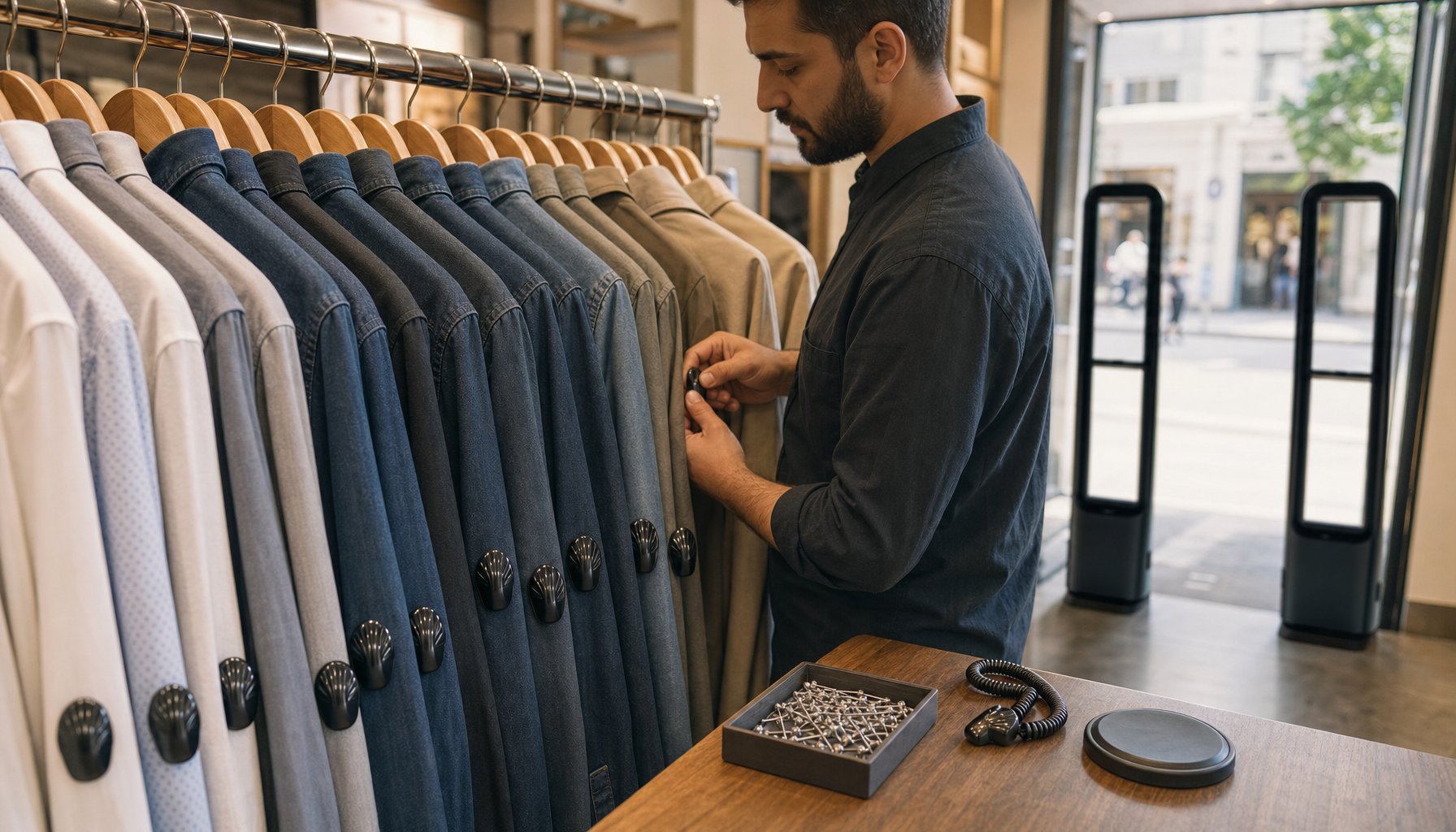
Shell tags, golf tags, pen tags and pencil tags go on outerwear, coats, jackets, jeans and bags. They're removed at the till with a detacher and go straight back into circulation. Count these against your stock on hand, not your sales.
Soft labels — a consumable
Soft labels stick onto sock packs, underwear, packaged scarves, fragrance and small items. They're deactivated at the till and leave circulation for good. Count these against your monthly sales, the same way you'd budget for carrier bags or price stickers.
Lock in your system frequency before you order
AM tags work with AM gates, and RF tags work with RF gates. The two are not interchangeable — and every month we come across stores that have bought several thousand tags on the wrong frequency. If you haven't bought your gates yet, choose the gate type first at vista-eas.com, then order tags.
The formula for how many clothing tags your store needs
Our base formula for hard tags looks like this:
- Hard tags = (average taggable stock × coverage factor) × (1 + safety buffer)
And for soft labels:
- Labels = monthly sales of label-suitable items × months of supply × (1 + wastage)
Here's what each variable means:
- Average taggable stock: the physical piece count on rails, shelves, window displays and front stock on a normal trading day. If your business is seasonal, use your peak-season figure (the holiday rush, or your busiest sale period) rather than the annual average.
- Coverage factor: what share of your items genuinely take a hard tag. In apparel this is usually between 0.85 and 1.
- Safety buffer: tags that have been removed at the till and haven't made it back to the rail yet, plus tags being repaired or simply lost. We suggest 0.15 to 0.20 (that's 15% to 20%).
- Label wastage: labels that go on crooked or tear. Budget around 0.10.
Coverage factor by product type
| Product type | Recommended protection | Coverage factor |
|---|---|---|
| Coats, jackets, outerwear | Shell or golf hard tag | 1.00 |
| Shirts, T-shirts, blouses | Pencil or pen hard tag | 1.00 |
| Denim and fabric trousers | Shell hard tag | 1.00 |
| Footwear and bags | Lanyard tag (cable tag) | 0.90 |
| Socks, underwear, packaged scarves | Soft label | 0 (counted as labels) |
| Low-value items | Optional | 0.50 |
Worked examples: three store sizes
Let's run the formula on three real-world stores so it clicks.
Store one is a 60 m² boutique carrying around 800 pieces, 90% of it outerwear. The maths: 800 × 0.90 = 720, then 720 × 1.20 = 864. Sensible order: 900 hard tags.
Store two is a 150 m² womenswear store with 2,500 pieces. The maths: 2,500 × 0.95 = 2,375, then 2,375 × 1.20 = 2,850. Sensible order: 3,000 tags.
Store three is a 400 m² apparel superstore with 9,000 pieces. The maths: 9,000 × 0.90 = 8,100, then 8,100 × 1.20 = 9,720. Sensible order: 10,000 tags.
| Store | Taggable stock | Coverage factor | Hard tag order | Detachers |
|---|---|---|---|---|
| 60 m² boutique | 800 | 0.90 | 900 | 2 |
| 150 m² store | 2,500 | 0.95 | 3,000 | 3 |
| 400 m² superstore | 9,000 | 0.90 | 10,000 | 5 |
For soft labels, say store two sells 600 sock and underwear units a month and wants six months of supply: 600 × 6 × 1.10 = 3,960 — call it 4,000 labels, or four rolls of 1,000.
Tag attrition: the number everyone forgets
Hard tags themselves rarely go missing. Tag pins are another story. Pins get dropped on the floor at the till, end up tangled in garments, or go out with the rubbish. Across the stores we supply, roughly 3% to 5% of tags and 10% to 15% of pins drop out of circulation each year.
That's why we always recommend:
- Add 10% to 15% spare pins to your first order — pins are sold separately and they're cheap.
- Place a small top-up order each year, around 5% of your total tag count, so your coverage never slips.
- Keep a dedicated box for removed tags next to every till. That one habit alone halves your attrition.
Detachers and gates: two more numbers to budget for
Buying tags without detachers is pointless. The simple rule: one detacher per active till, plus one spare for the store. If you have fitting rooms and re-tag garments there, add a detacher for the stockroom too.
Gate numbers depend on the width of your entrance, not on your tag count. Each AM aisle covers up to around 90 cm and each RF aisle up to around 120 cm; wider entrances need an additional centre pedestal. You can compare acrylic, metal and concealed floor-mounted models with full specifications in the retail security gates section of vista-eas.com.
Five common mistakes when ordering clothing tags
- Ordering by floor area: a densely racked 50 m² shop can need more tags than a minimalist 120 m² one.
- Tagging only expensive stock: this effectively tells shoplifters which rails are unprotected and pushes the risk onto your mid-range items.
- Buying one tag style for everything: a shell tag leaves a large hole in a fine shirt. Delicate fabrics need pencil tags or lanyard tags.
- Skipping spare pins: three months in, half your tags are sitting in a box with no pin.
- Ignoring peak season: order against a quiet summer stock count and you'll be short right when the holiday rush hits.
Final checklist before you place the order
- Is the system type confirmed? (AM or RF)
- Have you counted physical peak-season stock?
- Is the coverage factor set by fabric and product type?
- Have you added a 15–20% safety buffer?
- Are soft labels costed separately?
- Are spare pins and enough detachers in the basket?
If every box is ticked, your final number is ready to order.
Still not sure? Let us do the maths
If you'd rather sanity-check the number with someone, the Vista Gate team will run the calculation for you free of charge. Just tell us your floor area, an approximate piece count, your dominant product type and your entrance width, and we'll tell you exactly how many hard tags, soft labels, pins and detachers you need — and which gate model suits your layout. Head to vista-eas.com to see prices and place an order, or call our team now for free advice. Getting the number right once protects your store for years.