How to Evaluate Security Product Warranties: Buyer's Guide
When you buy an EAS gate, hard tags, RF labels or CCTV cameras for your store, you are really buying two things: hardware, and a commitment to stand behind that hardware. Experience shows the second part matters more, because a dead gate or a broken detacher is exactly as useful as having no system at all on your busiest trading day. Yet most buyers ask only one question: "How many months of warranty does it come with?" That question is incomplete. In this guide you will learn how to evaluate security product warranties against technical, measurable criteria, so you can see the real risk on paper before you pay.
What is a security product warranty, and how does it differ from a seller's promise?
A warranty is a written commitment from the manufacturer or importer to remedy defects in design and workmanship within a defined period. In the retail anti-theft market, however, there are three separate layers that routinely get confused with one another:
- Manufacturer's warranty: covers the core parts such as the antenna board, transmitter and receiver; usually administered through the official distributor in your country.
- Distributor or importer commitment: this is the one you actually turn to in practice — replacement, repair and local parts supply.
- After-sales service: installation, frequency tuning, calibration, scheduled inspections and staff training. This layer normally sits outside the warranty and needs to be spelled out explicitly in the contract.
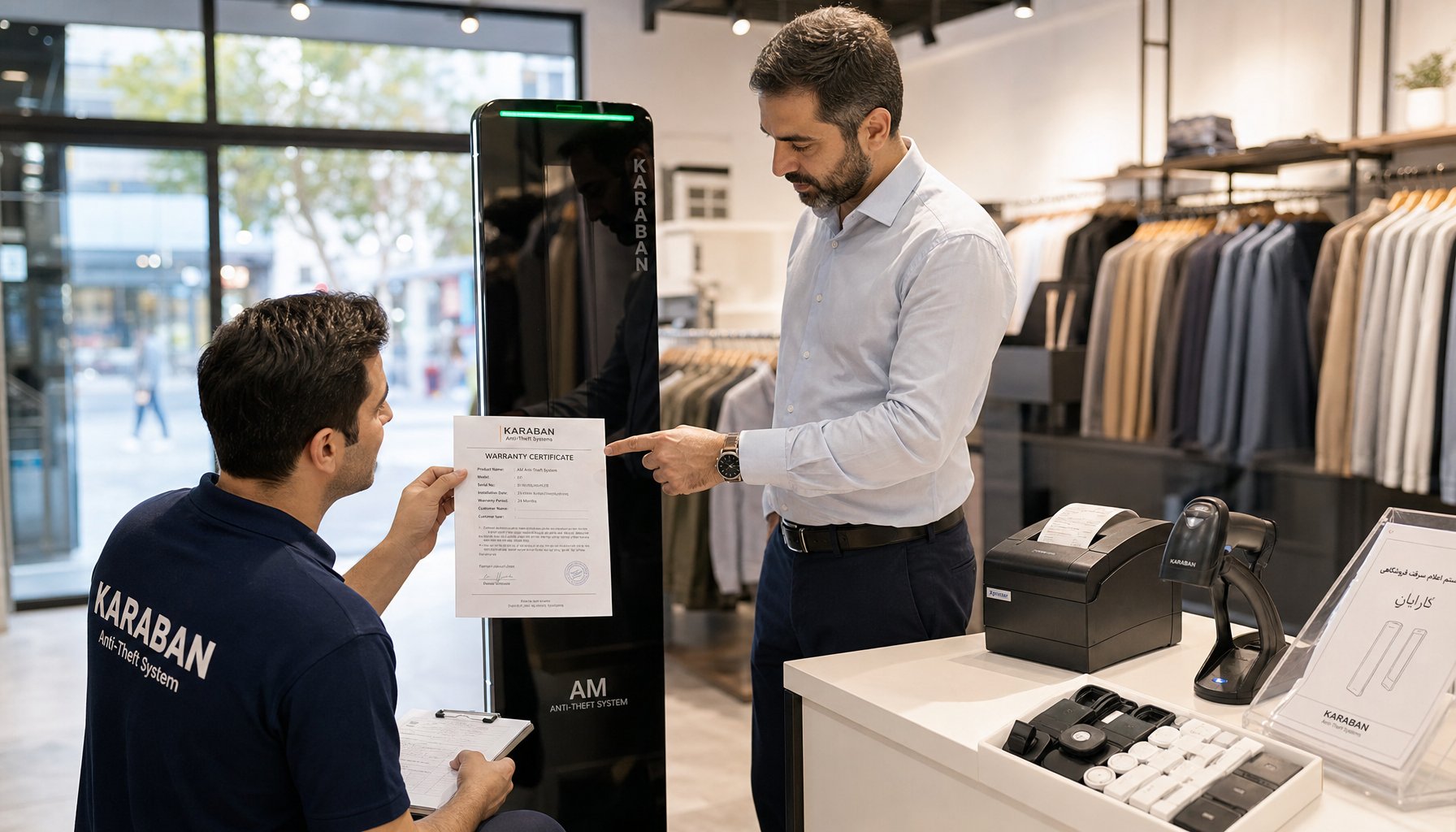
If a seller folds all three into a single line — "18 months warranty" — they have told you nothing yet. Evaluating a warranty properly means pinning down exactly what each layer covers, for how long, and how fast.
Seven criteria for evaluating an anti-theft equipment warranty
1. Which parts are actually covered
In an AM or RF retail gate, the expensive components are the electronics board and the antenna. Ask whether the main board is covered, or only the housing and accessories. With CCTV it is the image sensor and power adapter; with a thermal printer, the print head; with a barcode scanner, the laser head or imaging module. Those are precisely the parts most often written out of coverage.
2. Coverage period, broken down by component
A single blanket period is rarely honest. For example, 24 months on the housing and board, 12 months on the adapter and 6 months on the backup battery is a structure you can actually rely on. "36 months on everything" with no breakdown usually means the exclusions are hidden somewhere else.
3. Response time and time to repair
This is the single most important criterion for a high-traffic store. Ask for two separate numbers: how many hours until a technician first responds, and how many business days until the problem is fully resolved. For supermarkets and chain retailers, a commitment of 24 to 48 business hours is a reasonable benchmark.
4. Loaner unit during repair
If your gate goes back to the workshop, how many days does your store stand unprotected? Supplying a loaner unit for the duration of the repair is the difference between a ceremonial warranty and an operational one. Get this clause in writing.
5. Spare parts supply and product support life
Ask how many years after this model is discontinued spare parts will still be available. Suppliers who hold local parts stock effectively give you a longer warranty than the number printed on the certificate.
6. Where the service is performed
Is service carried out on site at your store, or do you have to ship the unit out? Who pays the technician's travel costs and the shipping? For stores outside major cities, this clause can affect total cost of ownership more than the purchase price itself.
7. The provider's track record
A warranty certificate is worth exactly as much as the company behind it. Years in business, a landline number and a physical address, and reference customers in a business like yours that you can actually call — three simple, effective tests. At vista-eas.com you can review the technical specifications and support terms for each product line before you even pick up the phone.
Comparing warranty levels for retail equipment
The table below is a comparison framework. Print it and fill in a column for every supplier you talk to; any blank you can't fill is the hidden risk in that purchase.
| Criterion | Weak warranty | Acceptable warranty | Professional warranty |
|---|---|---|---|
| Main board coverage | 6 months | 12 months | 24 months or more |
| First response time | Unspecified | 72 hours | 24 business hours |
| On-site service | Not offered | At customer's expense | Free during warranty period |
| Loaner unit | Not offered | Subject to availability | Committed in writing |
| Spare parts | Ordered case by case | Limited stock | Local stock, guaranteed for years |
| Staff training | Not offered | One on-site session | Training plus ongoing phone support |
Warranties on consumables: tags, labels and pins
For consumable items such as hard tags, RF labels and magnetic pins, "warranty" means something different. Instead of a time period, look for a guaranteed defect rate:
- The share of dead or inactive tags per box — under one percent is generally acceptable.
- A guaranteed detection range at the gate's standard aisle width; a label that only reads from 20 centimetres away is defective in practice.
- A commitment to replace out-of-spec batches without putting the customer through elaborate testing.
- Guaranteed compatibility between the tag and the frequency of your installed gate — this is the classic failure point when tags are bought from a random third-party seller.
Before placing a bulk order, get a sample box and test it on your own gate. The Vista Gate tag and label range is organised around exactly this logic, so frequency compatibility is clear from the start.
Warranty-voiding clauses to read before you sign
The most important part of any warranty certificate is the list of exclusions. These are the clauses that cause the most disputes in the security equipment market:
- Installation by an unauthorised party: if you or the store's electrician relocate the gate, the warranty may be void. Even a simple move requires the frequency to be retuned.
- Power surges: many warranties exclude surge damage. A surge protector — plus a small UPS in larger stores — protects both the equipment and your warranty.
- Environmental interference: installing a gate next to an electrical panel, an automatic door or heavy steel structures can cut sensitivity, and the supplier won't count that as a product defect. A pre-installation site survey removes the argument entirely.
- Damaged serial label: photograph the hologram and serial sticker and keep it in your store file.
- Improper use: with detachers and thermal printers, using unsuitable consumables is the most common reason a warranty claim gets rejected.
Calculate total cost of ownership, not just the purchase price
Here is how to compare two gates with a significant price gap: purchase price, plus the estimated cost of likely failures over three years, plus the cost of leaving your entrance unprotected on the days the system is down. A cheaper gate with a weak warranty that goes down for a week twice a year ends up more expensive in year one alone — because its real cost is the theft that never got recorded on those days. For clothing and jewellery stores, where the value per item is high, this calculation almost always favours the stronger warranty.
Final checklist before you pay
- Read the warranty certificate before you pay, not at delivery.
- Ask for the coverage period broken down by component.
- Get response time and repair time as numbers, in writing.
- Clarify the loaner-unit arrangement.
- Establish who pays travel and shipping costs.
- Read the exclusions list in full and ask for written clarification of anything vague.
- Keep the official invoice, the unit serial number and the support phone number in your store file.
Get expert advice
If you want to know which gate, which tags and what level of support make sense for your floor area, product mix and footfall, you don't have to sift through the market yourself. Vista Gate specialists review your entrance layout and product range and give you a technical recommendation along with clear, written warranty terms. Visit vista-eas.com to browse the products and request a consultation, or call the sales team so you have the full picture of cost and support for the next three years before you buy.