
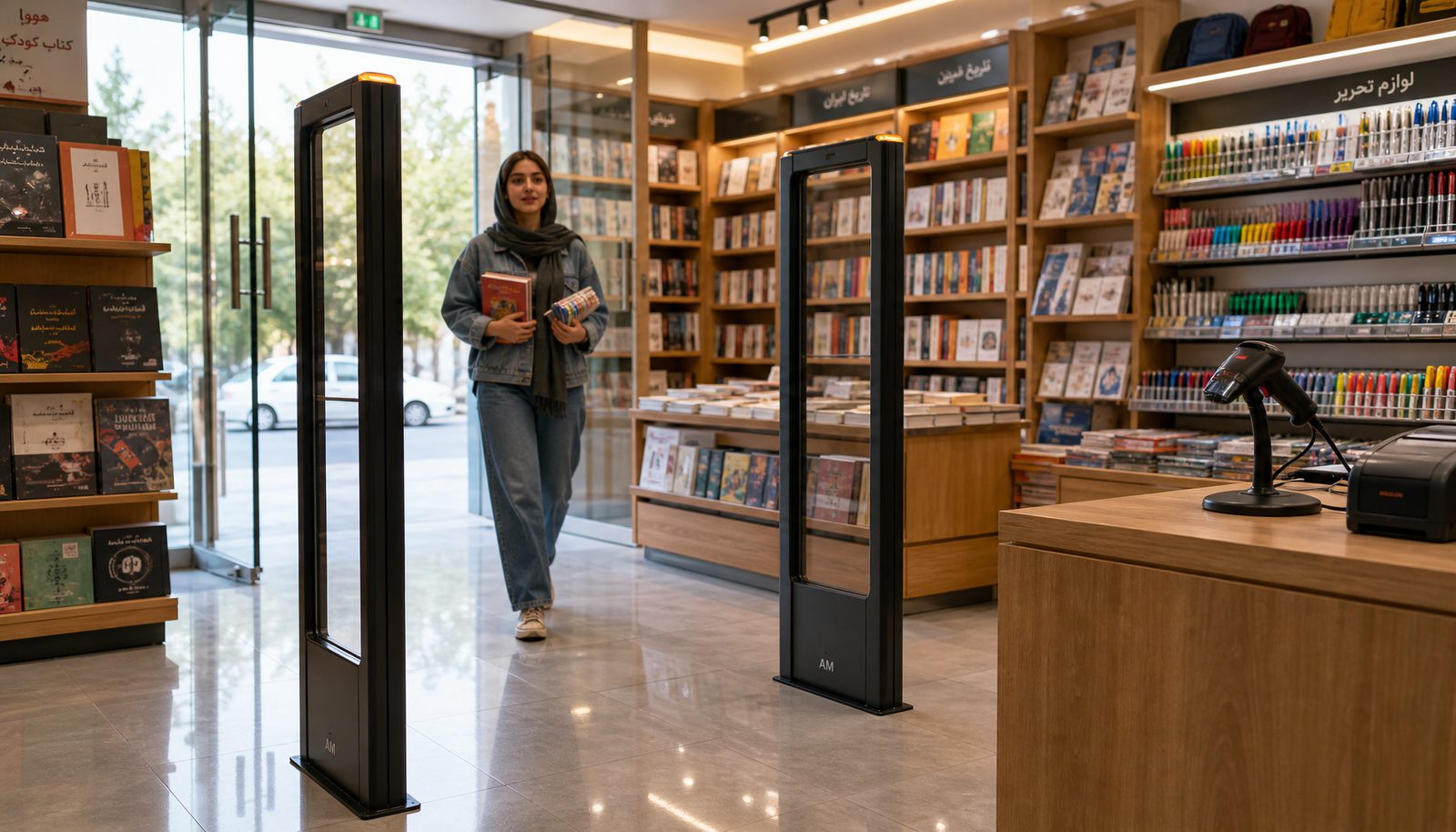
Bookstore & Stationery Store Security With EAS Gates
Why security matters in a bookstore or stationery shop
Bookshops and stationery stores look like calm, low-risk places, but statistically they are among the most exposed retail categories for petty theft. The reason is simple: the product range is enormous, the items are small, the unit price looks trivial at a glance, and a customer can linger between the shelves for a long time without ever looking suspicious. Put those factors together and shrinkage in this sector easily reaches 2 to 5 percent of annual sales - a figure that, for many stores, wipes out several months of net profit.
The key point is that theft here is rarely one big hit; it happens drop by drop. A 250,000-toman rollerball, a set of design markers, an imported notebook and a pocket paperback add up over a month, and by year end they produce a number nobody saw coming. Because the loss never shows up in the moment, most owners have no idea how deep it runs until stocktake - and by then, tracing who took what is effectively impossible.
The good news is that securing a bookstore or stationery shop is entirely manageable with today's equipment, and you don't have to turn your shop floor into something cold and policed to do it. Below we spell out exactly which products to protect with which tools, and where to spend your budget first.
The highest-risk products in bookstores and stationery shops
Before you buy any equipment, you need to know where you are bleeding. Experience across real stores puts the protection priorities roughly in this order:
- Branded and imported stationery: premium pens and rollerballs, watercolour marker sets and professional coloured pencils - small, expensive and easy to pocket.
- Slim, high-demand books: pocket paperbacks, language titles and study guides, all with an active second-hand market.
- Digital accessories: flash drives, headphones, scientific calculators and chargers, now a fixture in the modern stationery aisle.
- Art supplies: acrylic paints, brushes, canvases and calligraphy tools - pricey and sold in small packaging.
- Everyday consumables: glue, cutters, erasers and batteries; cheap one by one, but stolen in serious volume.
There is a simple rule of thumb: anything priced above your average basket that fits in the palm of a hand needs physical or electronic protection.
Retail security gates: the first line of defence in a bookstore
The single most effective security layer for this sector is a retail security gate at the entrance and exit. The gate communicates with the tag or label attached to the product, and if that item passes through the doorway without being deactivated, the alarm and warning light trigger. More important than the alarm itself is the deterrent effect: simply seeing a gate at the door takes a large share of opportunistic theft off the table before it ever starts.
AM or RF gates - which suits a stationery store better?
Two technologies dominate the market, and picking the wrong one wastes your money:
| Feature | AM gate (acousto-magnetic) | RF gate (radio frequency) |
|---|---|---|
| Operating frequency | 58 kHz | 8.2 MHz |
| Coverage width per aisle | Up to roughly 180 cm | Up to roughly 120 cm |
| Sensitivity to metal and noise | Low | Moderate to high |
| Best suited to | Large bookstores, hypermarkets, wide entrances | Small and mid-sized shops with narrow entrances |
| Relative cost | Higher | More economical |
For large bookstores and stationery shops with a wide entrance, or with metal shelving close to the door, an AM gate is usually the sounder choice because its false-alarm rate is lower. For neighbourhood shops with an entrance under 120 cm, an RF gate with paper labels does the job at a lower cost. Models from both families, with full technical specifications, can be compared at vista-eas.com, and our specialists will give you a precise recommendation based on your entrance layout.
The right anti-theft tags and labels for books and stationery
A gate without the right tags is just expensive decoration. Your choice of protection has to match the material and packaging of each product:
- Soft labels: thin paper labels hidden between the pages of a book or under the barcode on a stationery pack. The cheapest option at volume and ideal for bookstores.
- Hard tags: for bulkier packs, school bags, pencil cases and boxed art supplies; fitted with a pin or lanyard and removed at the till with a detacher.
- Clear safer boxes: for small, high-value items such as flash drives, scientific calculators and premium pen sets - the product stays visible but out of reach.
- Cable tags: ideal for cardboard boxes that a pin would damage.
One practical note: the label should sit somewhere the customer won't notice while flicking through a book. Always placing it on the back cover effectively teaches a seasoned shoplifter exactly where to look. Vary the placement across different titles, and use two layers of protection on your highest-risk lines.
CCTV and managing shelf blind spots
A gate stops tagged stock walking out the door, but CCTV does two other jobs: it documents incidents for follow-up, and it keeps an eye on the till. In book and stationery stores, tall shelving is the biggest enemy of clear sightlines. Stick to a few simple principles:
- One camera of at least 4 megapixels aimed directly at the till and the cash drawer.
- One camera facing the entrance to capture the faces of everyone coming in, mounted at around 220 cm.
- Aisle cameras positioned along the length of each aisle, not across it, so the whole run is covered.
- A live monitor in customer view; seeing themselves on screen multiplies the deterrent effect.
- At least 15 days of recording, stored on a surveillance-grade hard drive.
Together, a security gate and CCTV give you full coverage: one stops stock leaving, the other preserves the whole story of what happened.
Supporting equipment: barcode scanners, thermal printers and physical locks
Part of your shrinkage isn't customer theft at all - it's human error at the point of sale. When a sales assistant keys in prices from memory, stock discrepancies are inevitable. A fast barcode scanner paired with a thermal receipt printer shortens the queue at the till and keeps your system stock aligned with what is actually on the shelf. Without that alignment, you will never know how much real theft you are dealing with.
Alongside that, laptop locks and security stands for the digital section, lockable display cabinets for premium lines, and safer boxes for shelves out of the cashier's line of sight are all essential. A full range of this equipment, along with consumables such as labels and detachers, is available at vista-eas.com, so you can source your entire security setup from one supplier.
Store layout and processes that bring theft down
Equipment alone never performs to its full potential without the right process behind it. The following cost nothing and make a real difference:
- Merchandise expensive, small items within direct view of the till, not at the back of the store.
- Keep mid-floor shelving below 150 cm so staff sightlines aren't broken.
- Make the exit a single route; several open doors mean several risk points.
- Train staff to handle an alarm politely and never to accuse a customer; the right line is that the item's label probably wasn't deactivated.
- Run a stocktake every three months so you can see the trend in your losses, not just the final number.
- Keep the area behind the till off-limits to customers and the cash drawer in camera view.
Cost, return on investment and a sensible starting point
The question every owner asks is whether the investment is worth it. A back-of-the-envelope calculation is usually convincing: if a store is losing 15 million toman of stock a month, one gate set plus consumable labels typically pays for itself within 3 to 6 months, and everything after that is straight profit.
| Stage | Action | Expected result |
|---|---|---|
| Step one | Install one security gate set at the exit | A marked drop in opportunistic theft |
| Step two | Label books and branded stationery | Coverage of fast-moving stock |
| Step three | Safer boxes and hard tags on high-value items | Protection of your best margins |
| Step four | CCTV and barcode scanning | Stock transparency and documentation |
You don't need to buy everything at once. Start with an exit gate and labels, measure your losses three months later, and add the next layers based on a real number.
Summary and free consultation
Security in a bookstore or stationery shop isn't an extra cost; it's insurance that hands you back the profit you were quietly losing every month. The right combination of retail security gates, tags and labels matched to your stock, CCTV and a transparent sales process cuts shrinkage to under a third in most stores.
If you aren't sure whether an AM or RF gate suits your floor space and entrance, talk to the Vista Gate specialists today. Just tell us your entrance dimensions and a list of your highest-risk products, and we'll send you a technical recommendation with accurate pricing. To browse models, read the full specifications and request a free consultation, visit vista-eas.com or call our support lines; our specialists respond in less than one working day.