Best EAS Gate Installation Companies in Iran + Buyer Guide
If you run a shop, a hypermarket or a clothing boutique and your shrinkage figures keep nagging at you, you have probably already decided it is time to install retail security gates. But there is a question that matters even more than “which system?”: which EAS installation company? In this article we walk through the criteria that separate the best EAS gate installation companies in Iran from the rest, the differences between the technologies, what actually drives the price, and the buying mistakes that cost store owners money — so you can decide without learning the hard way.
Why the installer matters more than the gate itself
Plenty of retailers assume that buying a good-quality retail security gate is the end of the security story. Experience in the Iranian market says otherwise. Even the best gate in the world will misbehave in two irritating ways if the pedestals are spaced incorrectly, if they sit next to a source of electromagnetic interference such as an electrical panel, an automatic door or a commercial refrigerator, or if the frequency is never properly calibrated: false alarms on innocent shoppers, and dead silence when tagged merchandise walks straight out.
After a few days of that, staff stop taking the alarm seriously, and the system you paid for becomes an expensive piece of decor. So searching for “the best EAS gate installation companies in Iran” is exactly the right search. The installer decides how precisely your system is tuned, which tags and labels go on your merchandise, how many years it runs without failing, and — when something goes wrong in the middle of a packed Thursday evening — who actually picks up the phone.
How to spot the best retail EAS gate installers
The anti-theft equipment market in Iran is crowded, and almost everyone claims to be “the best.” But there are a handful of objective criteria you can test with a few simple questions.
1) A site visit before the sale
A company that quotes a price over the phone without ever seeing your entrance is selling you a product, not a solution. Door width, floor material (stone, tile or raised flooring), the cable route for power, the distance to the checkout counter and the amount of metal in the structure all affect which gate model is right. A real specialist checks these things in person or over video, and only then makes a recommendation.
2) Technical expertise and an in-house install team
Some sellers hand the installation off to day-rate contractors. An in-house install team means the person who shows up for service next year is the same person who tuned the system and already knows the conditions in your store.
3) A broad product range, not a single brand
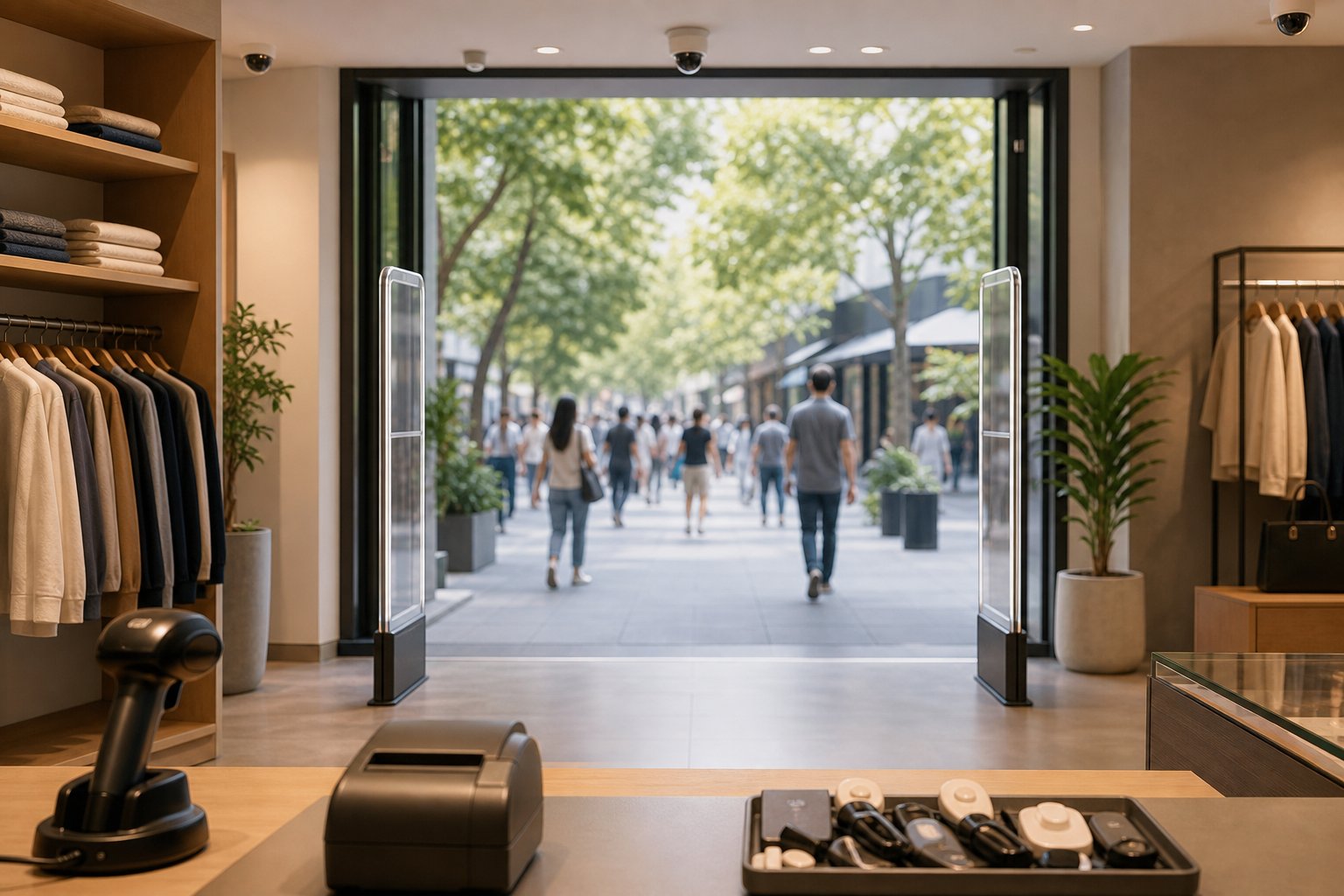
A company that stocks only one gate model has no choice but to sell you that model. A supplier like vista-eas.com — which carries both AM and RF gates, hard tags, paper labels, detachers and deactivators, barcode scanners, thermal printers and CCTV — can choose based on what you actually sell rather than what is sitting in the warehouse.
4) A clear warranty and transparent after-sales support
The key question is: “What exactly does the warranty cover, and what is your response time?” A credible company gives you a written warranty, states the term precisely, and explains the difference between the warranty and long-term after-sales support. “Don’t worry, we’ll look after you” is not a warranty.
5) A reliable supply of tags and labels
You buy the gate once, but labels are a consumable. If a company cannot keep supplying labels and tags matched to your system’s frequency for years to come, it has effectively left you in a dead end. Before you buy, ask how many rolls they hold in stock and how the price per thousand is calculated.
6) References you can actually check
Ask for the names of two or three stores in your own city where they have installed a system. A short phone call to those stores is the most honest assessment of installation quality and support you will ever get.
Gate technologies and what installers should know about them
Part of being professional is picking the right technology for your type of retail. Three technologies are common in Iran:
| Technology | Best for | Main advantage | Limitation |
|---|---|---|---|
| AM (58 kHz) | Hypermarkets, supermarkets, pharmacies, cosmetics | Wide detection range, up to roughly 6 ft (180 cm), and stronger resistance to interference | Higher price and bulkier tags |
| RF (8.2 MHz) | Apparel, bags and footwear, small home appliances | Cheaper labels and a wide choice of tags | More sensitive to metal, liquids and ambient noise |
| EM | Bookstores and libraries | Slim strips that can be reactivated | Short range and limited applications |
One important note: if your store carries a lot of liquids or metal packaging, a consultant who jumps straight to cheaper RF without asking any questions is lowering your cost today and raising your headaches tomorrow.
What determines the price of EAS gate installation in Iran?
The final price is never a single fixed number — it depends on a combination of factors. The table below explains why two quotes can differ so much.
| Factor | Effect on cost |
|---|---|
| Gate technology (AM or RF) | The biggest single factor; AM systems are usually more expensive |
| Number of antennas and door width | Every extra antenna needed to cover a wide opening adds cost |
| Housing material (acrylic, MDF, metal, glass) | A noticeable difference in both price and how the store looks |
| Type and quantity of tags and labels | A recurring consumable cost that belongs in your annual budget |
| Cabling and floor conditions | Stone floors or the need for surface trunking increase installation labour |
| Accessories | Detachers, deactivators, barcode scanners and CCTV |
For an accurate, up-to-date quote, share your product list, door width and number of branches so you get a proposal built around your store — that is exactly what the quote request form at vista-eas.com is for.
What a professional installation actually involves
If a company skips these steps, it is not the right choice no matter how low the price:
- Site visit and interference survey: measuring ambient electromagnetic interference with a dedicated meter, before any model is chosen.
- Choosing the technology and model: based on your merchandise, the width of the entrance and the store’s design.
- Mechanical installation and cabling: anchoring the pedestals, routing cables safely, and a dedicated, properly grounded power supply.
- Calibration and field testing: tuning sensitivity with real tags, at different heights and different walking speeds.
- Staff training: how to tag correctly, how to use the detacher, and how to handle an alarm professionally.
- Handover documents: the written warranty, a support number and a scheduled service plan.
Common mistakes retailers make when choosing an installer
- Choosing purely on the lowest price, without looking at label costs over the long run.
- Buying a gate online with no installation service, then handing calibration to a local electrician.
- Skipping staff training — a tag applied in the wrong place is as useless as no tag at all.
- Relying on the gate alone and ignoring the supporting layers: CCTV, safer boxes for small high-value items, and laptop locks in the electronics section.
- Not asking the simple question: “If an antenna fails six months from now, how many days until it’s repaired?”
Vista Gate: a dependable choice among Iran’s EAS installers
With years of experience equipping clothing stores, hypermarkets, pharmacies and jewellery shops, Vista Gate starts the job with a site visit and an interference survey — not with an invoice. The product range covers AM and RF gates in acrylic and MDF housings, hard tags and paper labels of every kind, detachers and deactivators, barcode scanners, thermal receipt printers, CCTV and safer boxes. In other words, you can source your entire security and checkout chain from one place and stop worrying about equipment that doesn’t work together.
Every product comes with a written warranty and after-sales support, and consumable labels are supplied on an ongoing basis. If you run multiple branches, a single standard can be designed across all of them so that staff training and consumable supply stay simple.
Summary and your next step
The best EAS gate installation company is not necessarily the biggest or the most heavily advertised. It is the one that visits your store before selling anything, recommends the right technology, puts the warranty in writing, keeps your labels in stock, and is still reachable after the installation. Ask any company about those five things and your shortlist will shrink within minutes.
Take the next step now: for a free consultation, help choosing the right technology for your type of retail, and a quote built for your store, talk to the Vista Gate team or fill in the site visit request form at vista-eas.com. Our specialist will assess your entrance and give you a technical and pricing proposal at no cost.