EAS Gate Repair Service: How to Choose a Reliable One
No retailer wants to start the day with a security gate that shrieks for no reason — or, worse, one that quietly lets tagged merchandise walk straight out the door. The reality is that a retail security gate is like any other piece of electronics: sooner or later it needs servicing and repair. The hard part is usually not the fault itself; it is finding an EAS gate repair service that genuinely knows what it is doing. This guide spells out what a good repair service looks like, what you can check yourself before you pick up the phone, which questions to ask, and where to be careful.
Why do retail security gates fail?
Anti-theft gates — whether AM or RF — are not simple devices. They combine a transmitter antenna, a receiver antenna, a control board, a power supply and software-side sensitivity settings. Knock any one of those links out of balance and the whole system either alarms for no reason or goes effectively blind. The most common causes of gate failure in everyday retail environments are:
- Power surges, and the lack of decent surge protection, which hit the board and power supply directly
- Changes to the store layout — a display fridge, a checkout counter or cheap LED lighting installed near the gate, all of which create frequency interference
- A loose or broken sync cable between the two pedestals, especially where the cable runs under flooring and gets trodden on
- Physical knocks from shopping carts or stock being moved through the entrance
- Sensitivity settings thrown off by amateur tinkering
- Components reaching the end of their service life, particularly on second-hand or very old gates
- Poor-quality tags and labels, or ones that do not match the gate frequency
Signs your gate needs a technician
- False alarms, especially at certain times of day
- Reduced detection range — a tag is only picked up when it practically touches the pedestal
- One-sided detection: only one of the two pedestals is working
- The indicator light or the people-counter display no longer comes on
- A continuous beep, or the unit resetting over and over
- A pedestal running unusually hot, or a burning smell around the board
Check these yourself before you call a repair service
A large share of the calls our support team gets are not faults at all. Before you pay for a technician visit, spend a few minutes on the basics:
- Make sure the adapter and the outlet are working and the power lead is seated firmly
- Walk a known-good test tag through the middle of the gate to find out whether the problem is the gate or your tags
- Temporarily remove any large metal object, monitor, Wi-Fi router or phone charger you have recently put near the gate
- Check whether the store next door has just installed a gate of its own; interference between two gates close together is one of the most common causes of false alarms
- Unplug the unit completely, wait about 2 minutes, then plug it back in
If the problem is still there after all that, it is time for a specialist. At vista-eas.com you can run your gate details past a technician before you commit to anything, so you know whether you are really dealing with hardware or just with settings.
What makes a good EAS gate repair service
Repairing anti-theft gates is a narrow specialty, and plenty of people move into it from CCTV or intercom work. The criteria below help you tell a professional from someone learning on your equipment.
1. Expertise in both AM and RF
Acousto-magnetic (AM) gates run at 58 kHz; radio-frequency (RF) gates work around 8.2 MHz. The diagnostic logic, the test equipment and even the way sensitivity is tuned are completely different between the two. A good repair service asks on the very first call whether your gate is AM or RF, which model it is, and what kind of tags you use. If someone quotes a price without asking any of that, be careful.
2. Diagnosis with instruments, not guesswork
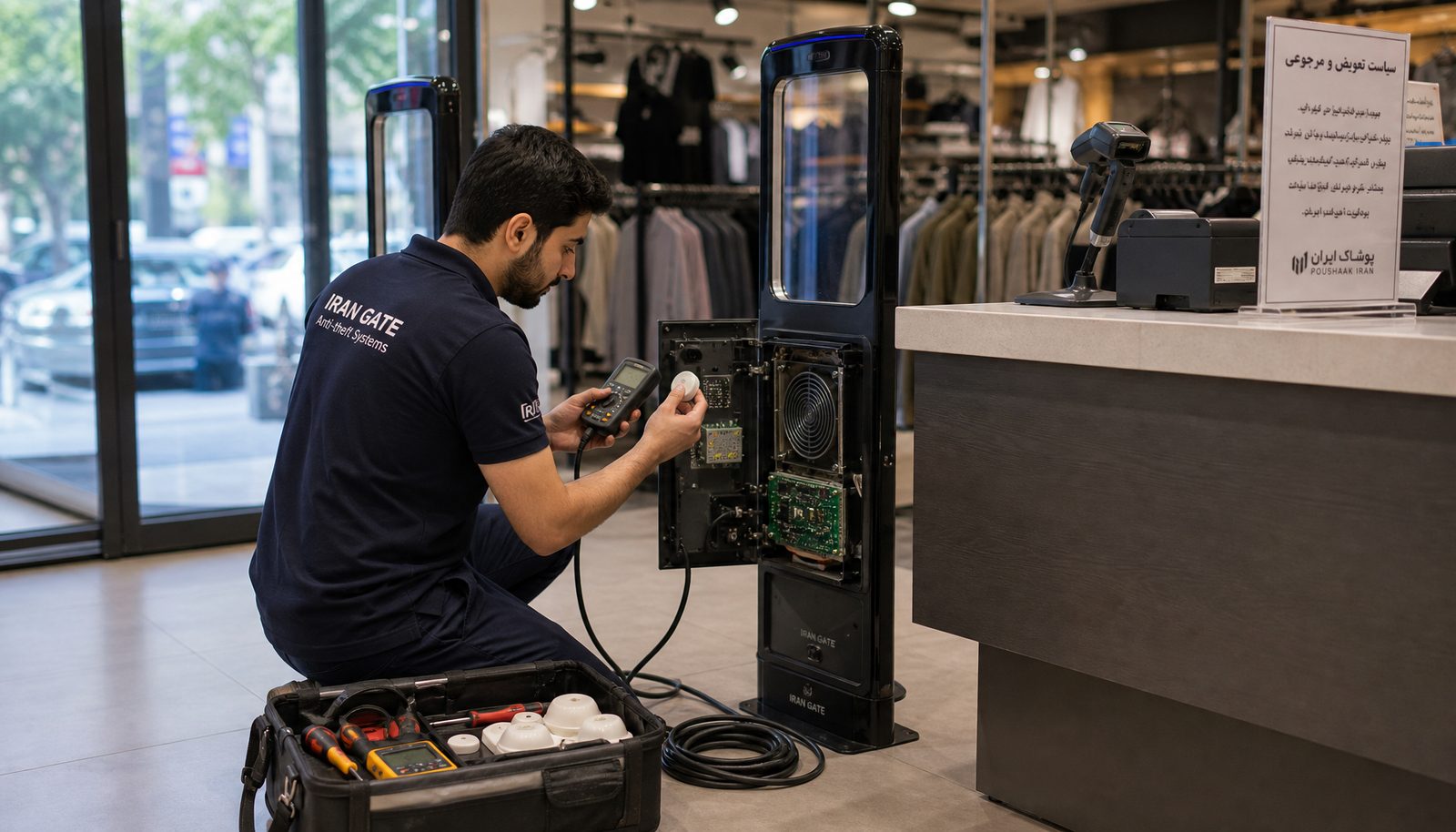
A professional technician turns up with a frequency tester, a multimeter and a reference tag. They measure ambient noise first, then check the antennas, and only then look at the board. Anyone who tells you within the first minute that the board is fried and has to be replaced is usually picking the easiest and most expensive route.
3. Genuine, compatible parts
The board, power supply, speaker and antennas all have to match your gate model. A generic third-party board on a branded gate may hold up for a few weeks, but it drags sensitivity down and eventually puts you right back where you started. A serious company is usually an importer or supplier in its own right — the way vista-eas.com supplies gates, tags and labels, and spare parts from one source.
4. A written warranty on parts and labor
The key question is simple: if the same fault comes back a month from now, what happens? A reputable repair service gives a written warranty on the replaced part and on the work itself, and issues a proper invoice. No invoice means no leverage when you need to follow up.
5. Response time and technician dispatch
For a supermarket or a clothing store, every day the gate is down is a direct shoplifting risk. A good service commits to a dispatch window instead of a vague we will get someone out soon. Coverage in your area, and phone support for the simple stuff, are worth points too.
6. A track record you can verify
Ask about completed jobs — store names, installation photos, a previous customer you can call. A company that has spent years in retail equipment has a history you can actually check.
General repair tech or EAS specialist?
| Criterion | General repair tech | EAS gate specialist |
|---|---|---|
| Knowledge of AM and RF | Usually surface level | Specialist, model by model |
| Diagnostic equipment | A basic multimeter | Frequency tester and reference tag |
| Parts sourcing | Whatever equivalent the market has | Genuine, compatible parts |
| Final sensitivity tuning | By eye, to taste | To spec, verified with tags |
| Warranty on the work | Verbal, or none at all | In writing, with an invoice |
| Ongoing support | Unclear | Scheduled service contract |
7 questions to ask before you book a repair
- Which gate brands and technologies do you work on?
- What does the call-out and diagnosis cost, and is it deducted from the final bill if I go ahead with the repair?
- Is the replacement part genuine or an equivalent, and how long is it covered?
- Is the repair done on site, or does the unit have to go back to your workshop?
- After the repair, do you run pass-through tests with real tags and labels?
- Do you issue an official invoice and a warranty certificate?
- If the same fault comes back, how long do you cover follow-up free of charge?
What drives the cost of an EAS gate repair?
No honest technician quotes a firm number without seeing the unit. The variables, though, are predictable:
- The type of fault — sensitivity tuning and interference fixes are usually the cheapest outcome
- Parts — power supplies and speakers are inexpensive; the main board is the costly one
- Gate model and brand — the older and rarer the unit, the harder parts are to source
- Store location and the technician travel time
- Whether cabling has to be re-run or pedestals repositioned
One piece of plain economics: a single specialist repair almost always costs less than a few weeks of shrinkage with a dead gate. And a dead gate is more dangerous than no gate at all, because it hands you a false sense of security.
Repair or replace?
Sometimes repair is not the sensible call. Replacement tends to work out better if:
- The repair estimate comes to more than roughly half the price of a new gate
- The unit has been in service for 8 to 10 years and parts are no longer available
- The same fault has come back two or three times in a single year
- You have widened the store entrance and the current gate no longer covers it
- You want to move to more advanced tags, or add people counting and reporting
Routine servicing: the cheapest way to avoid repairs
An annual or six-monthly service visit — sensitivity testing, cable checks, cleaning inside the pedestals and an ambient-noise check — heads off most of the serious failures before they happen. Stores on a scheduled service contract end up spending less per year on their anti-theft equipment.
The short version, and free advice
It comes down to this: a good EAS gate repair service asks questions before it quotes a price, diagnoses with instruments, fits genuine parts, tests with real tags once the work is done, and puts its warranty in writing. If your store gate is alarming for no reason or missing tags, there is no need to burn time and money on trial and error.
The Vista Gate team is ready to look at your gate over the phone, send a technician out if it is needed, and tell you honestly when a repair is not worth it and what the alternatives are. For free advice and a cost estimate, call us today or message us through vista-eas.com and we will get back to you as quickly as we can.