
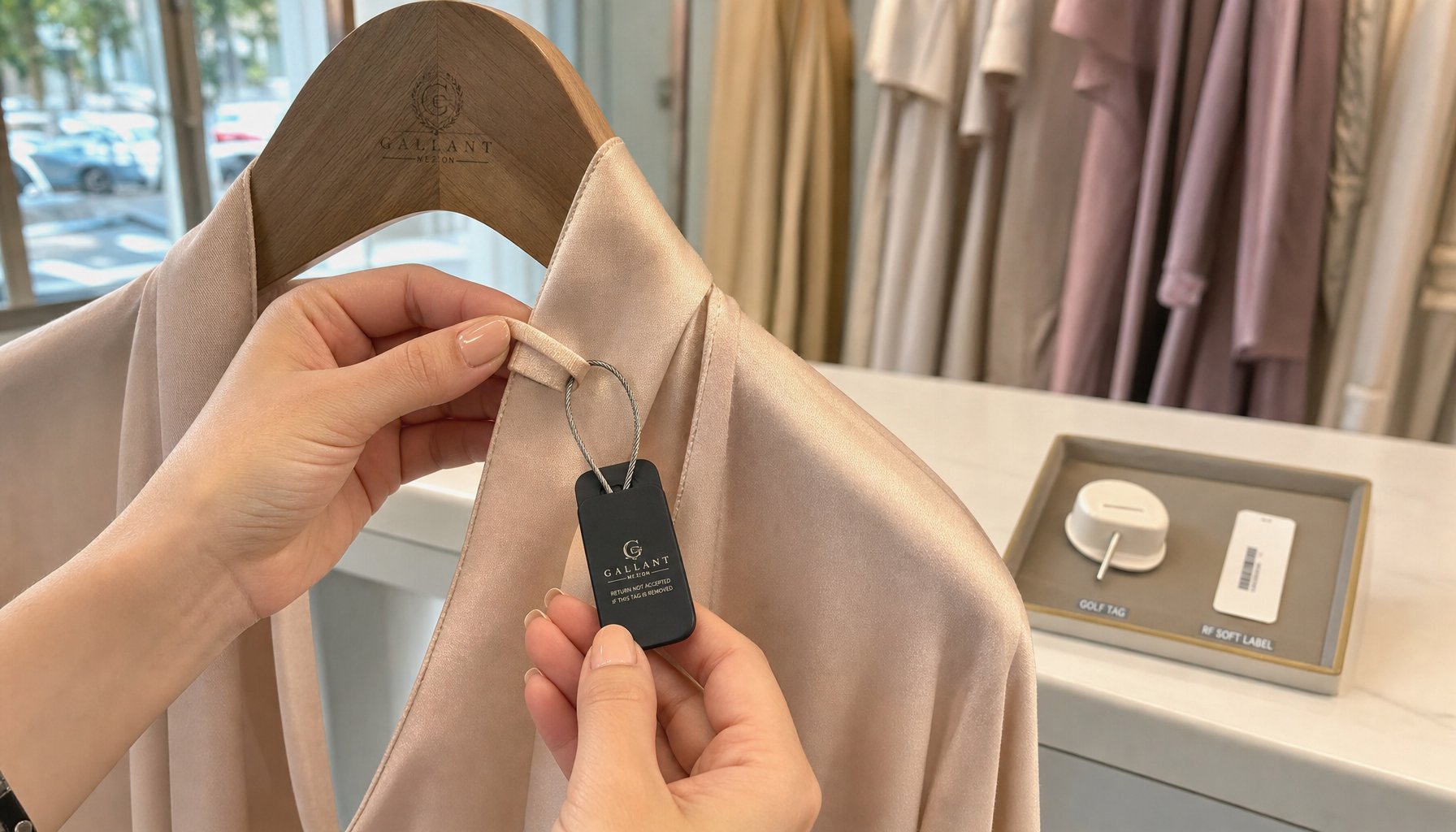
Clothing Tags on Delicate Fabric: Which Won't Leave Holes?
Any retailer who has ever inspected a chiffon coat or a silk blouse after taking the tag off knows the moment: a bright pinprick in the weave, threads dragged tight around it, and a customer saying quietly, “there's a hole in this.” On heavy garments like denim and outerwear, the mark left by a fine pin closes up on its own within a few hours. On delicate fabric the hole is permanent — which in practice means one more return. So the real question isn't whether to tag at all, because shrinkage in an apparel store climbs fast the moment merchandise goes untagged. The real question is: which clothing tag leaves no mark on delicate fabric? This article answers exactly that, comparing tag types, fabric types and fitting technique.
Why clothing tags cause trouble on delicate fabric
Retail hard tags work with a metal pin that passes through the fabric and locks inside the tag body. On coarse, heavy weaves the pin simply pushes the yarns aside, and once the tag comes off the fibres spring back into place. On the fabrics below, it's a different story:
- Silk, chiffon, satin and georgette: very dense weaves with fine yarns — instead of slipping between threads, the pin cuts straight through one.
- Fine knits and jersey: break a single loop and the whole run ladders.
- Leather and faux leather: the hole is permanent, because there are no fibres to recover.
- Coated and waterproof fabrics: a puncture breaks the coating and the garment stops doing its job.
- Eveningwear with tulle or beading: pressure from the tag body pulls the trim loose in one spot.
The other thing worth knowing is that a large share of the damage doesn't come from the tag at all — it comes from how it's removed. When a sales assistant tugs at a tag with a weak magnet or at the wrong angle, the pin rips the fabric before it fully releases. In other words, even the best clothing tag on the market will ruin delicate fabric if the detacher behind the counter isn't up to the job.
Types of clothing tag and how much damage each one does
Before you choose, it helps to see the full picture. The table below compares the common retail tag types by the risk they pose to fabric:
| Tag type | Attachment method | Risk of holes | Best for |
|---|---|---|---|
| Golf tag | Standard metal pin | High | Denim, coats, heavy apparel |
| Clamshell tag | Metal pin, wide body | Medium to high | Everyday apparel, bags |
| Micro pin tag | Slim pin, around 1 mm | Low | Shirts, lightweight fabric |
| Lanyard tag | Steel cable through a loop or label | None | Chiffon, silk, leather, bags |
| RF/AM soft label | Adhesive, on the tag or packaging | None | Packaged apparel, socks, lingerie |
| Clear safer box | Lockable case | None | High-value eveningwear, accessories |
As you can see, the last three options put no holes in anything. Let's look at each one in detail.
Pinless tags: the safest choice for delicate fabric
1. Lanyard tags — the number one option
Instead of a pin, a lanyard tag uses a coated steel cable that threads through an opening the garment already has and locks into the tag body. “Already has” is the key phrase: you're using a hole that exists, not making a new one:
- a buttonhole
- the hanger loop inside the collar
- the hole in the manufacturer's price ticket
- a zip pull, belt buckle or trouser loop
- the care label in the side seam
In practice, lanyard tags are the best answer for chiffon coats, silk shirts, eveningwear, leather jackets and even bags and shoes. The one thing to get right is cable length. Too long and garments hang badly on the rail; too short and customers struggle to try things on in the fitting room. Around 15–20 cm (6–8 inches) suits most apparel. You'll find AM and RF lanyard models in the tags and labels section at vista-eas.com, and you can order to match the frequency of your own store gate.
2. RF and AM soft labels
Soft labels are thin printed antennas with an adhesive backing that stick straight onto the item or its ticket. Since no metal ever enters the fabric, the risk of holes is zero. But they come with two limits:
- They don't adhere well to fabric itself and leave a residue, so they belong on the cardboard swing ticket, the price card or the packaging.
- They're single-use and must be deactivated at the till with a deactivator, not peeled off.
The common, cost-effective setup in apparel stores looks like this: a soft label inside the cardboard price ticket, plus a lanyard tag on higher-value pieces. That combination keeps costs under control and the fabric intact.
3. Safer boxes and lockable hangers
For very high-value items — bridal gowns, leather jackets, cashmere scarves — some stores use a clear lockable case or a dedicated security hanger that encloses the whole item or its strap. It costs more, but it stops theft while still letting customers touch and examine the goods.
If you have to use a pin tag
Sometimes your stock is mixed and you'd rather not buy two different tag types. In that case, skip the standard golf tag and go for a micro pin tag instead: the pin measures around 1 mm across, versus 1.6–2 mm on regular tags, and the tip slides between the fibres rather than cutting them. On top of that, follow these rules:
Safe places to attach a tag on a garment
- The seam: the strongest, lowest-risk spot — any mark disappears into the stitching.
- The care label: pass the pin through the label itself, not the fabric.
- Inside the cuff or along the bottom hem: if a mark does remain, nobody sees it.
- Never: the centre front, the collar, a printed graphic, or any stretch panel.
Most important of all, use a proper detacher with enough magnetic force. Weak or worn-out magnets are the single most common reason garments get torn at the checkout. When removing a tag, lay it flat on the detacher pad, hold the fabric steady with your other hand, and lift the tag away without pulling.
Quick selection guide by fabric type
| Fabric | Recommended tag | Where to attach it |
|---|---|---|
| Silk, chiffon, georgette | Lanyard tag | Hanger loop or buttonhole |
| Satin and eveningwear | Lanyard tag or safer box | Hanger loop inside the collar |
| Jersey and fine knits | Lanyard tag | Side-seam label |
| Leather and faux leather | Lanyard tag | Zip pull or belt loop |
| Lightweight cotton and viscose | 1 mm micro pin | Seam |
| Denim and heavy cotton | Standard golf tag | Seam or buttonhole |
| Packaged lingerie and socks | Soft label | On the packaging |
Five common mistakes that ruin fabric
- One tag type for everything: the money you save up front comes back as returns and forced markdowns.
- Tagging through folded fabric: the pin goes through two layers and the garment tears when someone puts it on.
- Using a worn-out detacher: magnets lose strength from knocks and drops — test yours once a year.
- Ignoring frequency: an RF tag does absolutely nothing on an AM gate (58 kHz). Know your gate's frequency before you buy tags.
- Not training staff: even the right tag will destroy fabric if it's fitted wrong. Ten minutes of training at handover prevents most of the damage.
Matching tags to your security gate: the step everyone forgets
Choosing a tag without considering the gate system is only half a decision. If your store runs an AM gate at 58 kHz, you need AM tags and labels; if it's an RF gate at 8.2 MHz, you need RF. Both lanyard tags and soft labels are made in both technologies, so neither one limits your options for delicate fabric. If you don't have a gate yet, or you're upgrading, our advice is to pick the gate technology first — based on your entrance width and the type of merchandise you carry — and build your tag mix afterwards. The specialists at Vista Gate on vista-eas.com will run that calculation for your store free of charge, and will send you sample lanyard tags before you place a bulk order so you can test them on your own fabrics.
Summary and advice
The whole article in one sentence: for delicate fabric, the lanyard tag is the best choice, the soft label is the economical companion to it, and if you have no choice but a pin tag, use a micro pin and pass it only through a seam or a label. Theft is a real cost, but your customer's garment shouldn't be the one paying it.
If you're not sure which combination fits your store, send us your product list and the fabrics you carry. The technical team at Vista Gate will put together a recommended mix of tags, labels and detachers based on your merchandise, your gate frequency and your budget. For free advice and today's pricing, call our specialists now or send us your request through the contact form at vista-eas.com.