
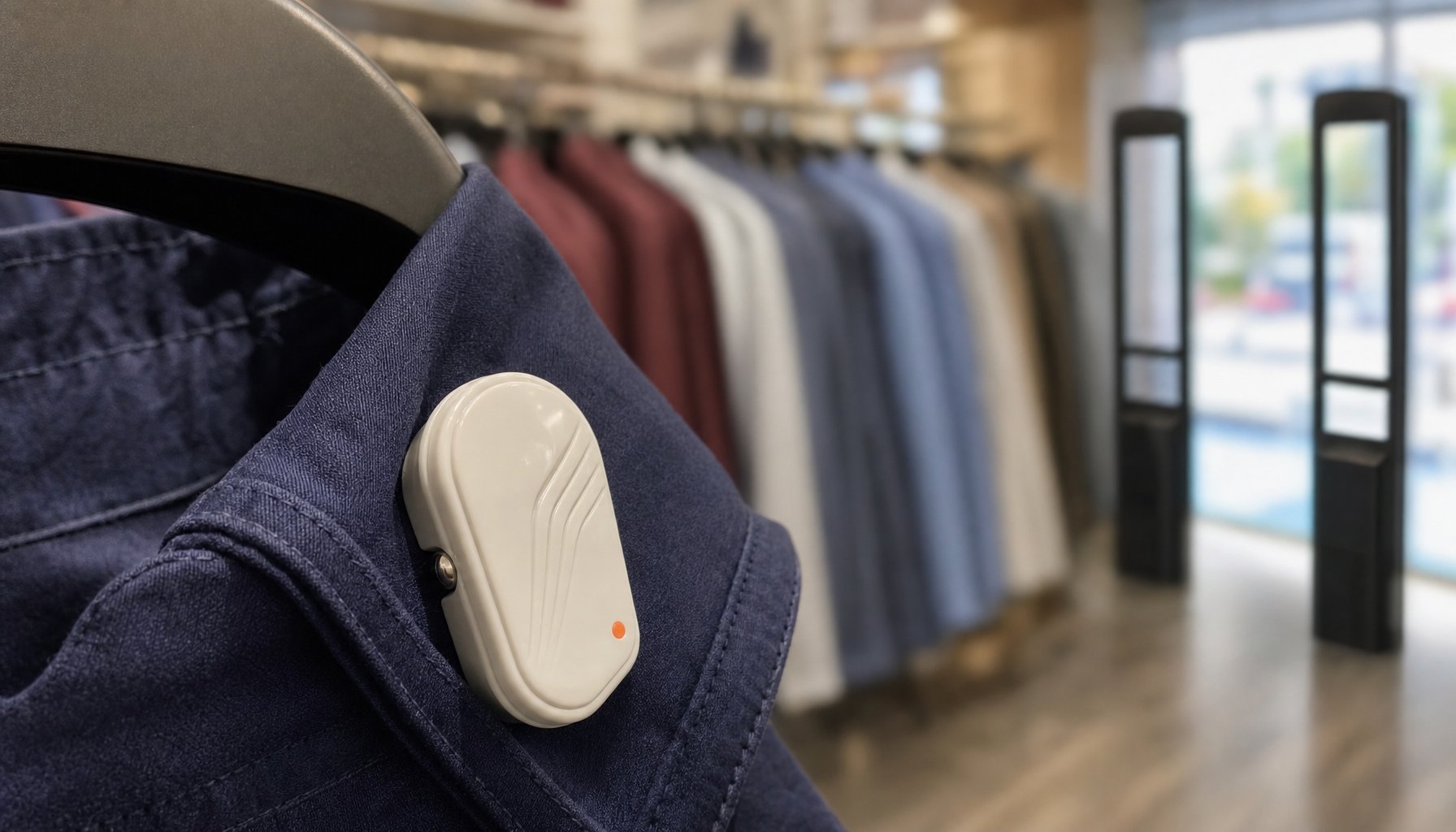
What Is a Clothing Security Tag? Full Guide
If you run a clothing store, you have probably looked at that small plastic tag clipped to a jacket sleeve or a denim seam and wondered what it actually does. A clothing security tag — the anti-theft tag used on apparel — is the simplest and, at the same time, the most cost-effective layer of security a retail store can have. Global retail figures show that shoplifting accounts for roughly 35 to 40 percent of stock shrinkage in clothing stores; for an average boutique, that can be the equivalent of several months of profit. This guide covers exactly what a clothing security tag is, how it works, which types exist, and how to choose the right one for your shop.
What is a clothing security tag, and how does it differ from an ordinary label?
A clothing security tag is a passive electronic device with no battery and no power supply of any kind. Inside the plastic housing sits a resonant circuit tuned to respond to an electromagnetic field at one specific frequency. The tag is one part of a larger system called EAS, or Electronic Article Surveillance, which has three main components: the tag, the store gate, and the removal tool.
The fundamental difference between a security tag and a price ticket or barcode label is that a barcode label only carries information and plays no part in security, whereas a clothing tag is an active alerting device. The tag does not stop the thief and it does not lock the garment; what it does is trigger an audible and visual alarm the moment the item passes through the doorway. Its psychological deterrent effect matters just as much as the alarm itself: most shop theft is unplanned, and simply seeing a tag on a garment sharply reduces the chance that anyone will try.
How does an apparel anti-theft tag work?
The way a clothing tag works rests on one simple piece of physics: resonance. The gates installed at the store entrance continuously generate an electromagnetic field in the space between the two pedestals. When a tag tuned to that same frequency enters the field, it begins to oscillate and reflect the signal back. The receiver in the gate detects that reflection and triggers the alarm. The whole process happens in a fraction of a second.
RF technology (radio frequency)
RF systems operate at around 8.2 MHz. In this technology, the tag is a simple capacitor-and-coil circuit. The main advantages of RF are a lower price and the option of thin paper soft labels, but it is more sensitive to metal and liquids, and its range is usually up to about 1.2 metres.
AM technology (acousto-magnetic)
AM systems operate at 58 kHz, and the tag contains two magnetic strips that vibrate mechanically when they receive a pulse and send a signal back. In clothing retail, this technology is considered the more professional choice thanks to its greater range (up to roughly 1.8 metres), a lower false-alarm rate, and better resistance to interference. The AM gate range available at vista-eas.com is designed for exactly this application.
Types of clothing security tags used in apparel stores
Not every garment can be protected with the same tag. Fabric type, thickness, item value, and how easily the material marks all determine which tag is appropriate.
- Shell hard tag: the most common type, suited to shirts, coats, jackets and jeans. It attaches to the fabric with a metal pin.
- Ink tag: contains a vial of permanent dye that stains the garment if anyone tries to force it open. Ideal for high-value apparel and luxury brands.
- Lanyard tag: secured with a thin steel cable around a bag handle, a belt or a trouser loop; ideal for items that must not be pierced.
- Soft label: a thin paper label stuck inside a pocket, under the size ticket, or on the back of sock and underwear packaging, and deactivated at the till.
- Fine-pin tag for delicate garments: a short pin with a wide head, for scarves, wraps, eveningwear and delicate fabrics.
| Tag type | Best for | Reusable |
|---|---|---|
| Shell hard tag | Shirts, trousers, outerwear | Yes |
| Ink tag | Luxury and branded apparel | Yes |
| Lanyard tag | Bags, footwear, belts | Yes |
| Soft label | Socks, underwear, accessories | No |
AM vs RF tags for a clothing store
Choosing between the two technologies is a decision that is hard to reverse later, because the tag and the gate have to run on the same frequency. The table below sums up the practical differences.
| Criterion | AM (58 kHz) | RF (8.2 MHz) |
|---|---|---|
| Coverage width per aisle | Up to about 1.8 m | Up to about 1.2 m |
| False-alarm rate | Low | Moderate |
| Tolerance of metal | Good | Weaker |
| Upfront cost | Higher | Lower |
| Recommended for | Hypermarkets and large apparel stores | Small, lower-traffic boutiques |
The full make-up of a clothing anti-theft system
A tag on its own achieves nothing. For the cycle to work, you need three more pieces:
- Store gate: two or more pedestals at the entrance that create the field and raise the alarm. The housing is usually clear acrylic, aluminium or MDF.
- Magnetic detacher: a unit with a powerful magnet (typically above 12,000 gauss) fitted at the till, which releases the pin lock. A weak detacher is the single most common reason tags get broken by accident.
- Deactivator: a pad that disables soft labels with a magnetic pulse so the customer can walk out without setting off the alarm.
Alongside these, many stores mount a CCTV camera directly facing the gate so that the moment of the alarm is captured on video. You can source the gate, detacher and camera together from vista-eas.com.
How to fit tags correctly on different garments
The golden rule: the seam, never the fabric
A tag should always go on a stitched seam or a thick hem, never in the middle of the fabric. A seam is multi-layered, so once the tag is removed the pin hole is invisible. Fitting a tag through single-layer fabric — especially satin, silk or fine cotton — leaves a permanent mark and leads straight to customer complaints.
Where to fit the tag by product type
- Shirts and blouses: the side seam, about 10 cm above the bottom hem.
- Jeans: the inner waistband or the back pocket seam.
- Jackets and coats: the inner sleeve seam or the hanging loop at the collar.
- Knitwear and stretch fabrics: always use a lanyard tag so the knit loops do not pull apart.
- Scarves and wraps: a short fine-pin tag on the stitched edge.
One more point worth noting: avoid placing the tag anywhere the customer has to push it aside while trying the item on. It spoils the shopping experience and makes a broken tag far more likely.
Common mistakes that make clothing tags useless
On technical visits to stores, the same handful of errors comes up again and again:
- Too much space between gate pedestals: if the entrance is wider than the chosen technology allows, a tag passing down the middle simply will not be detected.
- Switching the gate off at busy times: some staff turn the system off because of false alarms, which means the entire investment has been wasted. The right fix is adjusting sensitivity, not switching it off.
- Installing the gate next to an electrical panel or automatic door: electromagnetic interference causes alarms for no reason. Allow at least 1 metre of clearance.
- Mixing AM tags with RF gates or vice versa: a frequency mismatch means no alarm at all.
- No staff training: the cashier needs to know exactly what to say and do when the alarm sounds; handling it badly can turn into a customer complaint.
How to choose the right tag for your store
Before you buy, answer these four questions: how wide is your entrance? What is the average value of an item? What fabrics dominate your range? And how many customers pass through the doorway each day? For small boutiques with an entrance under 1.2 metres and lower-priced stock, an RF system with standard hard tags is enough. For large stores, chain branches and premium brands, pairing AM gates with ink tags is the most sensible choice.
When you work out the cost, look at the system as a whole rather than the unit price of a tag. Hard tags can be reused over and over and are effectively a one-off capital cost, whereas soft labels are a consumable. In practice, most clothing stores recover the cost of the whole system within a few months from reduced shrinkage alone.
Summary and free consultation
A clothing security tag is a simple piece of hardware with a direct effect on your store's bottom line — but it only delivers when the technology, the tag type, the fitting position and staff training all line up. If you are not sure which combination is right for your shop, there is no need to guess. The specialists at Vista Gate review your entrance layout, product mix and footfall, recommend the best configuration, and handle installation and training as well.
Get in touch with the Vista Gate team today for free advice and a quote on clothing security tags, store gates and detachers, or submit your request through vista-eas.com. The initial consultation is completely free, and all products come with a warranty.