Stop Retail Theft After COVID: A Store Owner's Guide
The pandemic and the reopenings that followed changed the way people shop — and with it, the way they steal. Stores that almost never saw serious shrinkage before 2020 now finish every stock count and discover that a chunk of their inventory walked out the door without a single receipt. The problem isn't just "thieves". It's a combination of new floor layouts, thinner staffing, higher product prices and new customer habits. This article is a hands-on look at how to prevent theft in the post-COVID market, and which retail anti-theft equipment actually earns its keep.
Why did shoplifting rise after COVID?
The jump in retail theft since the pandemic is no accident. There are a few specific causes, and they repeat across almost every retail category:
- Economic pressure: As prices climbed, the cash value of every stolen item multiplied. A T-shirt or a bottle of perfume that used to be a rounding error now wipes out the profit on several full sales.
- Fewer staff on the floor: Many stores cut sales headcount to control costs. Fewer eyes watching the floor translates directly into higher theft risk.
- Masks and face coverings: The habit of wearing a mask made it much harder to identify a shoplifter's face, and blunted the deterrent effect of cameras.
- Self-service layouts: To cut down on physical contact, a lot of shops moved stock within arm's reach of the customer. That open access multiplied the opportunity to steal.
- Organized retail crime: Small crews — one distracting the salesperson while another lifts the goods — have become far more active in recent years.
The new theft patterns in today's market
1. Small thefts, over and over
The most common pattern is lifting one or two small, expensive items: cosmetics, fragrance, phone accessories, medication and supplements. Each hit looks trivial on its own, but by month's end the total is anything but.
2. Price tag swapping
The customer peels the price label off a cheap item, sticks it on an expensive one and walks through the checkout. This kind of theft can't be proven on camera — you only catch it with barcode scanning and tight inventory control.
3. Internal theft by staff
In our experience working with chain retailers, a significant share of shrinkage starts inside the store: goods leaving without being recorded, unauthorized discounts for friends, or a receipt voided after the cash has been taken.
4. Theft during peak hours
The last hours of the day and sale days produce the highest theft numbers, because staff are tied up with the checkout queue and nobody is watching the sales floor.
Layer one: EAS security gates (AM and RF)
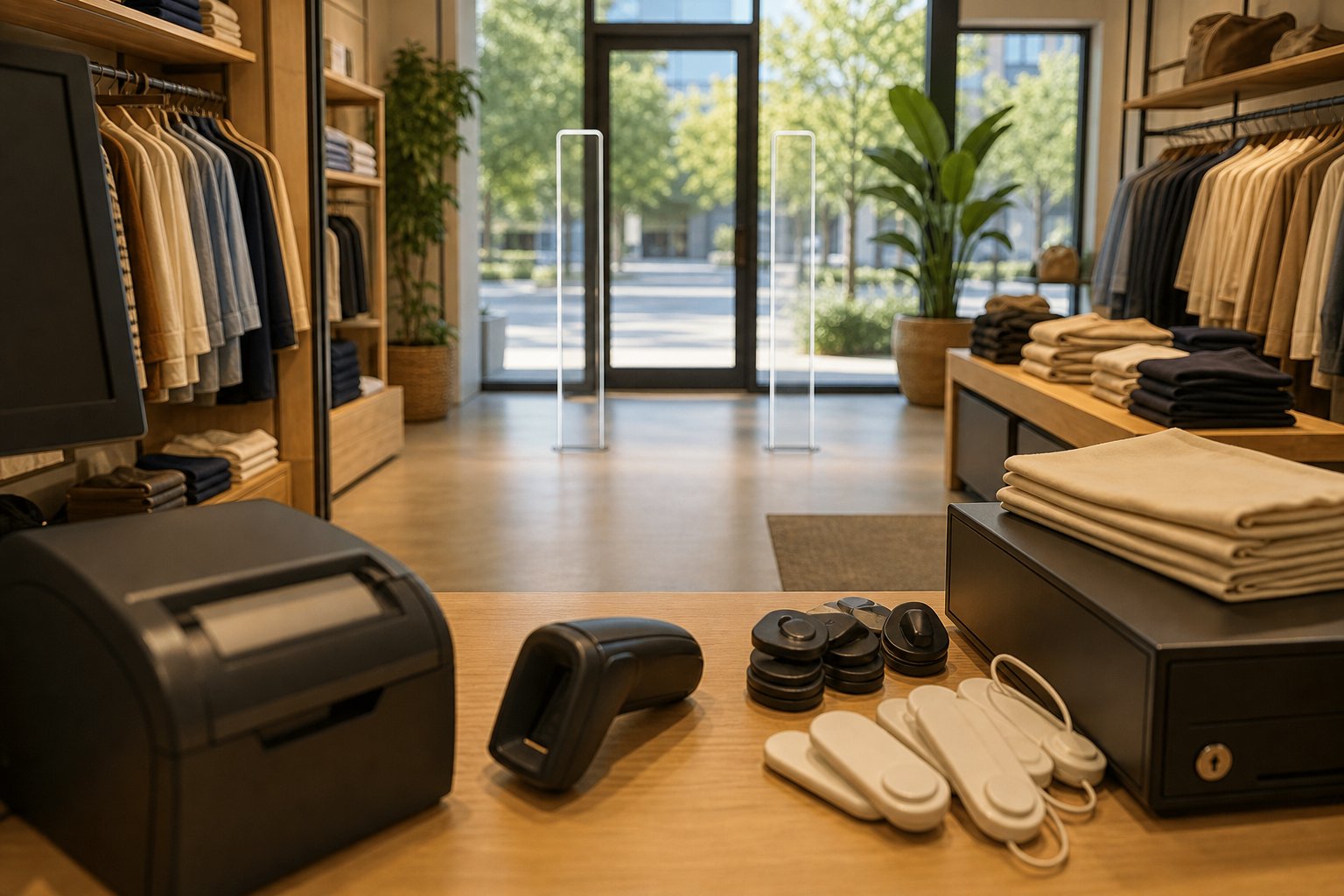
The fastest, most effective move against theft is installing an EAS security gate at the entrance. The gate works with security tags and labels, and sounds an alarm the moment an item that hasn't been deactivated passes through. More important than the alarm is the deterrent effect: when a customer sees a gate at the door, they don't take the risk.
There are two main technologies on the market:
| Feature | AM gate (Acousto-Magnetic) | RF gate (Radio Frequency) |
|---|---|---|
| Operating frequency | 58 kHz | 8.2 MHz |
| Detection width | Up to about 180 cm | Up to about 120 cm |
| Noise immunity | Very high | Moderate |
| Performance near metal and liquids | Good | Weaker |
| Best suited to | Hypermarkets, supermarkets, pharmacies | Apparel, bags and footwear, boutiques |
| Cost of consumable labels | Higher | Lower |
Which one you pick depends entirely on what you sell. For grocery stores and pharmacies, full of metal cans and liquids, AM is the right call. For an apparel store burning through a high volume of consumable labels, RF makes more sense on both cost and performance. If you're not sure which option suits your store, the specialists at vista-eas.com will review your floor plan and product mix and recommend the right model.
Layer two: matching the security tag or label to the product
A gate without the right tags is just expensive decor. The mistake stores make most often is buying one type of tag for everything. Here's how to choose:
- Shell and pencil tags: For heavy apparel, coats and denim. A strong pin that resists being pulled off.
- Fine-pin tags: For delicate fabrics, light coats and eveningwear, where you can't leave a large hole in the garment.
- Lanyard and cable tags: For bags, shoes, eyewear and anything a pin won't work on.
- Soft labels: For packaged goods such as medication, cosmetics, food and accessories. Single-use and very cost-effective.
- Safer boxes: For small, high-value items like razor blades, supplements, memory cards and phone parts.
- Laptop locks and rail locks: For electronics displays and clothing rails where an entire row of stock needs securing.
One practical note: the tag has to go somewhere it can't be removed without damaging the product. Tagging the edge of a sleeve or the hem of a fabric is effectively pointless.
Layer three: CCTV and smart video monitoring
The gate stops goods from leaving; CCTV does three other jobs — deterrence, proof and internal control. For the post-COVID market, keep these points in mind:
- Put at least one high-resolution camera directly over the checkout so that both the cashier's hands and the POS screen are in frame.
- Mount a camera at the entrance at face height. A ceiling camera looking straight down only records the tops of people's heads.
- Take the blind spots seriously — the fitting room, the far ends of the rails, the stockroom door. That's exactly where most theft happens.
- Keep at least 30 days of footage. Most shrinkage is discovered late, during a stock count.
- Put a live monitor where customers can see it at the entrance. It's the simplest and cheapest deterrent there is.
Layer four: store layout and staff training
A large part of loss prevention has nothing to do with equipment and everything to do with how the store is run:
- Never merchandise small, expensive items near the exit or on out-of-the-way shelves.
- Set shelf heights so the cashier has a clear line of sight across the whole floor.
- Count the garments going into the fitting room and hand out a numbered card.
- Train staff to approach a suspicious customer with "Hi, can I help you find something?" instead of a confrontation or an accusation. That one line stops most thefts.
- Run regular stock counts — quarterly at minimum — so you know what your real shrinkage is.
- Integrate your POS with a barcode scanner and a thermal printer so every item that leaves is recorded and price tag swapping becomes impossible.
A cost or an investment? A look at the payback
Most retailers see an anti-theft system as a "cost", but simple arithmetic says otherwise. Suppose an average apparel store loses just 10 items a month, at an average value of 1,500,000 Toman:
| Item | Approximate amount |
|---|---|
| Monthly loss from theft | 15,000,000 Toman |
| Annual loss | 180,000,000 Toman |
| One-time cost of gate system + initial tags | One-off investment |
| Typical payback period | Around 2 to 4 months |
What we see with stores that work with us is that after installing a gate and tagging consistently, shrinkage drops by 60 to 80 percent. In other words, an anti-theft system usually pays for itself in less than a quarter — and everything after that is straight profit.
Your action checklist: where to start
- Run a full stock count and pin down your real shrinkage figure.
- List your highest-risk products — expensive, small, in demand.
- Measure the width of your entrance so the number and model of gates can be set.
- Decide between AM and RF technology based on what you sell.
- Work out the mix of tags and labels you need, plus your monthly consumption.
- Identify your camera blind spots and cover them.
- Hold a 30-minute training session for your staff and put the rules in writing.
If you'd rather not work all this out by trial and error, we at Vista Gate have spent more than a decade designing and installing anti-theft systems for apparel stores, hypermarkets, pharmacies and jewelers. Just send us your floor plan — or even a single photo of your entrance — and we'll recommend the right solution, the number of gates and the right tag type, free of charge.
Call us today, or request a consultation through vista-eas.com. Our specialists will get back to you within a few hours, send you a quote, and arrange a site visit if you need one. Whenever you stop the losses, that's profit.