
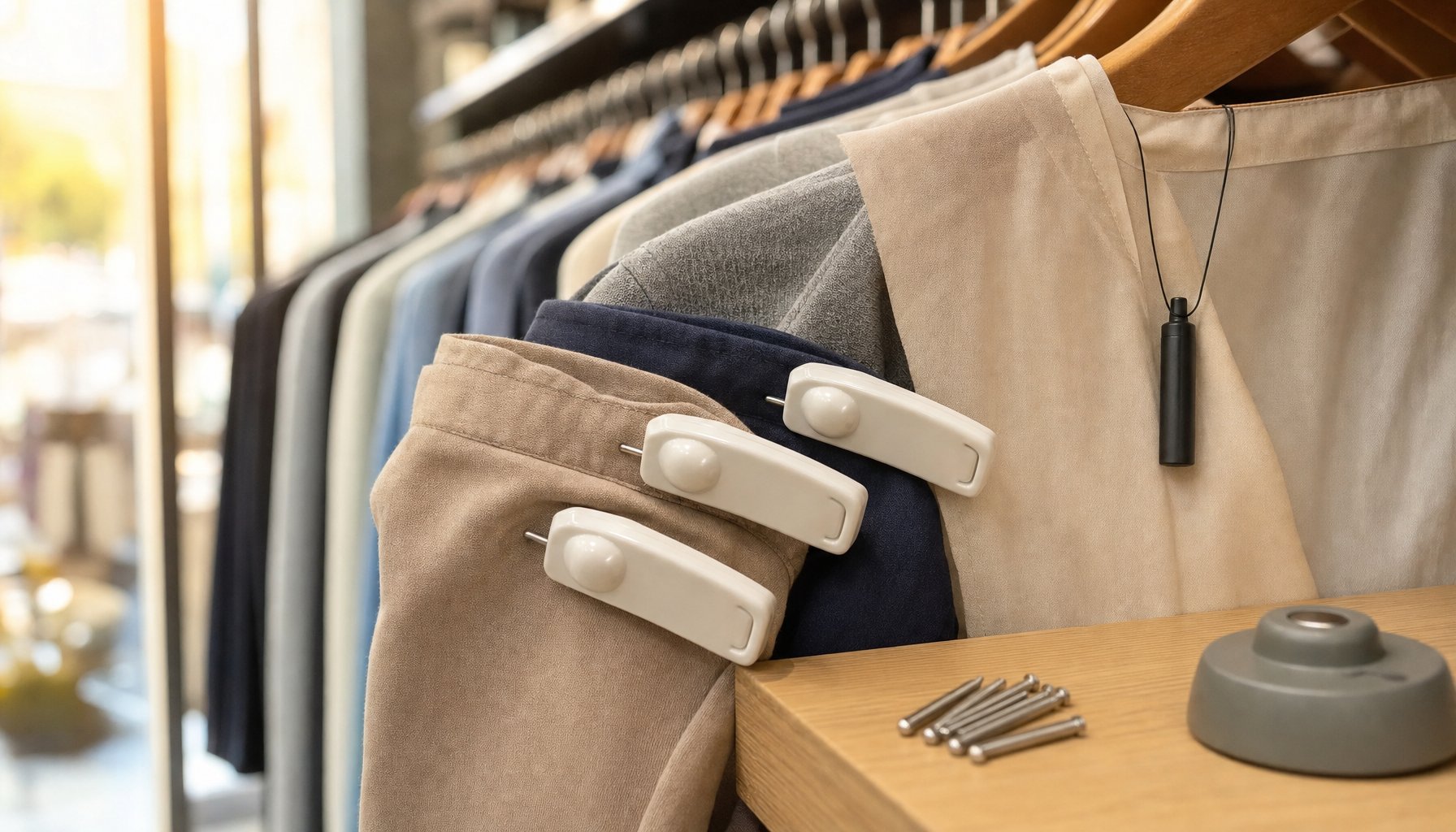
Clothing Security Tag Price: Cost Factors & Buying Guide
"How much does a clothing security tag cost?" is the first question almost every apparel retailer asks before putting an EAS system in. The short answer: anywhere from a few thousand toman to several tens of thousands per tag, depending on the housing, the technology inside it, the quality of the magnetic lock and how many you order at once. The more useful answer is understanding what actually moves that number — because the difference between a 9,000-toman tag and a 35,000-toman tag is not just how it looks. In this guide we break down how clothing security tag pricing is built, what types exist, and how to choose the right one for the Iranian market.
Clothing security tag prices at a glance
A security tag looks like a simple piece of hardware, but it is really three things in one: a plastic housing, an electronic core (an AM resonator or an RF circuit) and the magnetic lock assembly that grips the pin. The final price is the sum of how good those three parts are. The table below shows the approximate price range for the most common tag types on the Iranian market:
| Tag type | Price range per unit (toman) | Best for |
|---|---|---|
| Standard clam shell tag | 8,000 to 18,000 | General apparel, high-turnover stores |
| Pencil tag | 12,000 to 25,000 | Fine fabrics, eveningwear |
| Lanyard and cable tags | 15,000 to 35,000 | Bags, shoes, jackets, accessories |
| Ink tag | 25,000 to 60,000 | Premium labels, luxury boutiques |
| RF soft label (roll) | 350 to 900 | Socks, underwear, low-value items |
| Standard and long pins | 1,500 to 4,000 | Consumable, replaceable |
These are ballpark figures only — they shift with the exchange rate, your order volume and the manufacturer. For current, accurate pricing, browse the product list at vista-eas.com or ask for a direct quote.
Types of clothing security tags and how they move the price
Before you compare prices, you need to know which tag actually suits your merchandise. The wrong choice costs you twice: once at purchase, and again in damaged stock.
Clam shell tag
The market's best seller and the most economical option. It has a wide, shell-shaped housing that clips onto a seam or the edge of a garment. For high-turnover apparel stores on a tight budget, it offers the best value for money. The lower price comes down to a simple mould and high-volume production.
Pencil tag
Slim and elongated, it leaves a much smaller hole in the fabric. That single advantage puts it roughly 30 to 50 percent above a clam shell tag. If you sell eveningwear, chiffon or other delicate fabrics, that price gap is nothing next to the cost of a torn garment.
Lanyard and cable tags
Instead of a pin, these use a steel cable or an elastic loop, so they never pierce the item at all. They are the first choice for shoes, bags, belts and leather jackets. The extra cost is mostly down to the cable-locking mechanism and the quality of the cable itself.
Ink tag
The most expensive category, because on top of triggering the alarm it carries an ink vial that stains and ruins the garment if anyone forces it open. The psychological deterrent is enormous, and in a luxury boutique a single prevented theft pays for the whole batch.
RF soft label
A single-use label that gets deactivated at the till. The per-unit price is very low, but unlike a hard tag it cannot be reused. It makes sense for low-value items like socks and underwear — not for an expensive coat.
AM or RF: how the technology affects tag price
Here is the point most buyers discover too late: your tags have to match the technology of your security gates. An AM tag will not work with an RF gate, and vice versa.
- AM tags (58 kHz): More expensive to produce, because the core is a mechanical resonator. In return you get longer detection range, fewer false alarms and better performance in busy, electrically noisy environments.
- RF tags (8.2 MHz): Cheaper and simpler in construction. A solid budget choice for smaller stores with a narrow entrance, though they are more sensitive to metal and moisture.
That is why comparing the price of two tags without knowing their technology is meaningless. If you have not bought your gates yet, choose the gate type first and set your tag budget around it. You can compare AM and RF retail security gates with full technical specifications at vista-eas.com.
Seven key factors behind clothing security tag prices
When two suppliers quote different prices for what looks like the same tag, the difference almost always comes down to one of these seven things:
- Order volume: The single biggest lever. The unit price on a 200-piece order versus a 5,000-piece order can differ by as much as 40 percent. If you run a chain, consolidate your orders.
- Quality and ball count of the magnetic lock: Cheap 2-ball locks pop open with an ordinary magnet. Proper locks use 3 to 6 balls and need a strong detacher. This accounts for a large share of the price gap.
- Quality of the electronic core: A calibrated resonator means a higher detection rate and fewer false alarms. A cheap tag with a poor core means a gate that either stays silent when it shouldn't, or screams for no reason.
- Housing material: Virgin, impact-resistant ABS versus recycled plastic. A cheap housing cracks after a few open-and-close cycles and effectively becomes single-use.
- Pin quality: A plated steel pin will not rust or leave marks on white fabric. A cheap pin is exactly what turns a happy customer into a complaint.
- Exchange rate and import conditions: Virtually every tag on the market is imported, so prices move with the currency. Always check the date a published price was last updated.
- Supplier warranty and support: A supplier who guarantees replacement of defective units and continuous supply of the same model will naturally charge a little more — and will save you from the headache of mismatched tags a year or two down the line.
Hidden costs that don't show up in the tag price
Budgeting on per-tag price alone gives you an incomplete picture. Factor these in too:
- Detachers: You need at least one per till. A standard magnetic detacher is a one-off but essential cost; a weak one forces cashiers to yank at the tag, and garments get torn.
- Spare pins: Pins are the part that goes missing most often. Expect to replace roughly 10 to 15 percent of them each year.
- Tag loss and attrition: In busy stores a share of tags is lost or broken every year. For a realistic estimate, add 10 percent to your order quantity.
- Gates and installation: Tags do nothing without gates. If you are starting from scratch, the bulk of the investment is the gate, not the tags.
How many tags do you need, and when does it pay for itself?
A simple, practical rule: the number of tags you need equals the number of items on your rails and shelves, plus about 15 percent as a buffer for restocking. So an apparel store carrying around 1,000 items on the floor needs roughly 1,150 tags.
Now run the payback maths. If you buy those 1,150 clam shell tags at an average of 12,000 toman, your tag spend is about 13,800,000 toman. If the average garment in your store sells for 1,500,000 toman, stopping the theft of just 10 items over the year covers the entire cost. Experience across apparel retail suggests shrinkage typically runs between 1 and 3 percent of annual turnover — meaning an EAS system usually pays for itself in under a single season.
Buying guide: how to avoid cheap tags that cost you more
The cheapest tag on the market is almost never the least expensive choice. Before you place an order, check the following:
- Ask for samples and test them on your own gates — not once, but walking through at different distances and angles.
- Try the lock against an ordinary magnet. If it opens easily, that tag is just a piece of plastic.
- Confirm the supplier will still stock the same model later; a mix of mismatched tags makes life difficult at the till.
- Get written confirmation that the tag frequency matches your gates (AM or RF).
- Clarify the terms for replacing defective units.
- Compare prices with pins and detachers included, not just the tag body.
Vista Gate supplies clothing security tags in both AM and RF technologies, along with matching pins, detachers and gates, so the whole system works together. The full range of tags, labels and retail security gates is available at vista-eas.com.
Get advice and a current price quote
There is no single fixed price for a clothing security tag. It is a combination of what you sell, your gate technology, your order volume and the quality level you choose. If you are not sure which model suits your floor size and your product mix, get advice before you buy — one short call can prevent a costly mistake. The Vista Gate team can estimate the quantity you need, the right model and today's price for your store. Call now, or request a free quote through the consultation form on the website.