Why Vista Gate Beats Rival Retail Security Gates
Every store that sells small, portable goods runs into shoplifting sooner or later — items that walk out the door without a receipt and only surface at month-end as an unexplained gap in inventory. Industry figures put shrinkage at 1 to 3 percent of retail turnover worldwide, and in apparel and cosmetics that number sometimes climbs to 5 percent. The standard answer is the same everywhere in the world: a retail anti-theft gate. But the moment you start shopping, you are facing dozens of brands at dozens of different prices, and the decision gets difficult. This article explains, in detail and without the sales pitch, how Vista Gate differs from the competition and why it is the more sensible choice for a working retail store.
What is a retail security gate, and why does the brand matter?
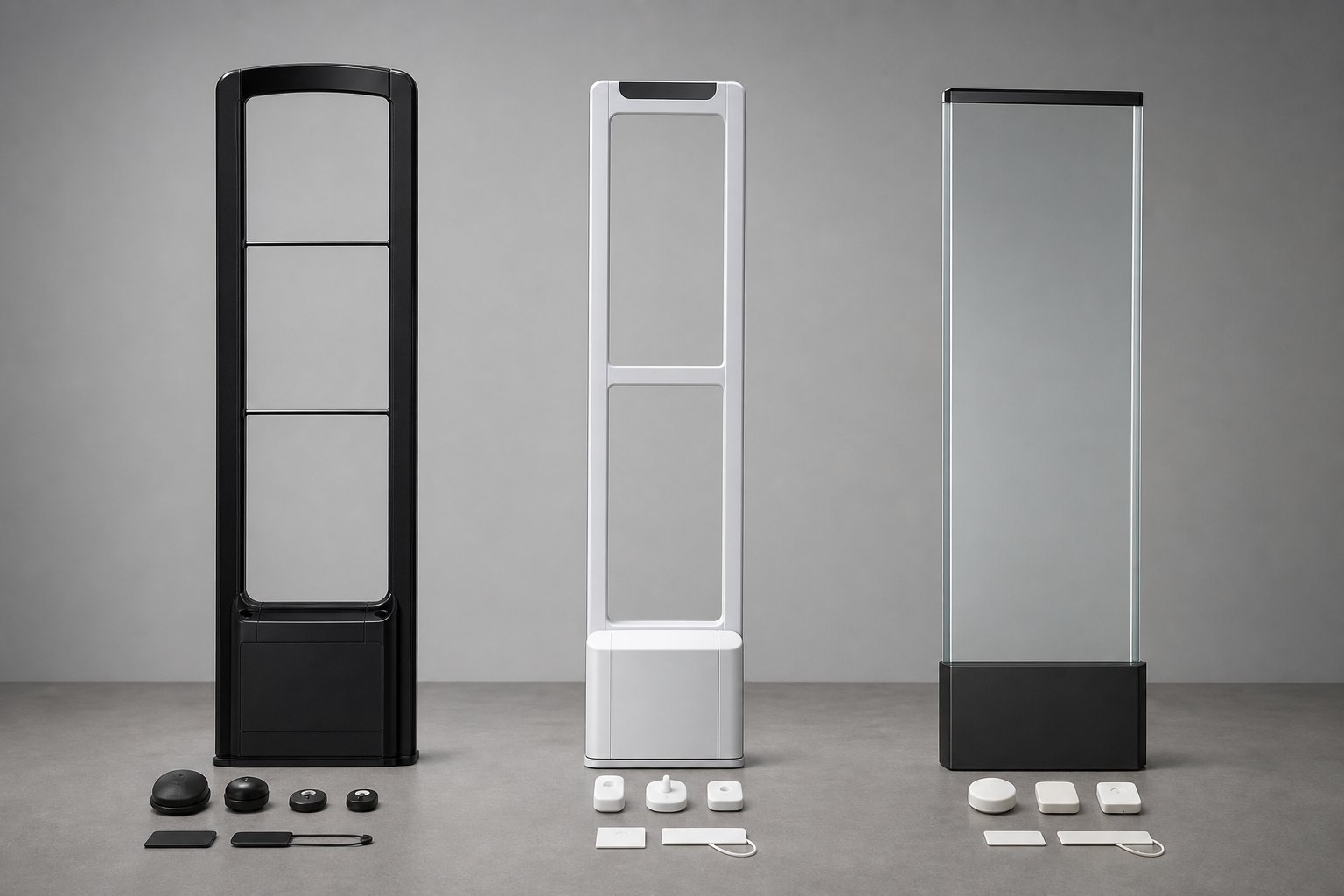
An anti-theft gate, or EAS system, has three parts: the antenna pedestals installed at the store entrance, the tags and labels applied to the merchandise, and the detacher or label deactivator that sits at the checkout counter. When a tagged item passes between the antennas, the gate's frequency field picks it up and the alarm sounds.
Up to that point, every brand looks the same. The real difference shows up when the store is busy, when there is a display fridge, a monitor, and a card terminal running next to the gate, when the doorway is wide, and when a customer walks through at speed. That is where a weak gate either alarms for no reason and embarrasses you in front of a customer, or misses the tag entirely and becomes nothing more than an expensive piece of decor. Choosing a brand means choosing that margin of safety.
AM vs. RF technology in Vista Gate systems — which one suits you?
Vista Gate offers both technology families and, unlike many sellers, will not push you toward whichever one it happens to stock.
AM gates (acousto-magnetic, 58 kHz)
This technology runs at 58 kHz, delivers a longer effective detection range (up to roughly 180 cm between pedestals), and stands up better to electromagnetic noise. For hypermarkets, cosmetics stores, pharmacy chains, and anywhere with a wide entrance or a lot of electrical equipment near the door, it is the first choice.
RF gates (radio frequency, 8.2 MHz)
RF runs at 8.2 MHz, its consumable tags and labels cost less, and for apparel, bags and footwear, and stores with a standard entrance up to about 120 cm, it is a genuinely economical option. If you get through a high volume of labels each month, RF keeps your running costs lower over the long haul.
On most quote requests, the seller simply recommends whatever model is sitting in the warehouse. The specialists at vista-eas.com start by asking about your entrance width, the type of merchandise you sell, your foot traffic, and the noise sources near the door — and only then recommend a model. That single step is the difference between a system that works and a purchase you regret.
Seven reasons Vista Gate outperforms the competition
- Quality housing and antennas: extruded aluminum profile and tempered glass instead of cheap ABS plastic that fades and cracks after one summer in the sun.
- Real, stated detection range: the range printed in the brochure is the range delivered in your store — not a lab figure achieved only in an empty room.
- Digital control board with sensitivity adjustment: precise on-site calibration, noise filtering, and adjustable detection thresholds, instead of fixed boards with a single trim screw.
- Full compatibility with tags and labels: Vista tags, soft labels, and detachers are matched to the gate, so you are not buying consumables from another brand and hoping they work.
- Spare parts always in stock: boards, speakers, power adapters, and antennas are available individually — one failed component does not mean scrapping the whole unit.
- Professional installation and on-site calibration: installed by a technical team, with walk-through testing using a range of different tags afterward.
- Clear warranty and reachable support: a written warranty with plainly stated terms, backed by phone support that actually picks up.
Vista Gate compared with typical market alternatives
The table below shows the concrete differences that rarely come up when you are collecting quotes, but make themselves obvious by year two:
| Criterion | Vista Gate | Unbranded market gates |
|---|---|---|
| Housing material | Extruded aluminum / tempered glass | Thin ABS plastic |
| Effective AM range | Up to 180 cm | Usually under 100 cm |
| Sensitivity adjustment | Digital, multi-step | Single analog screw, or fixed |
| False alarms | Rare, with noise filtering | Frequent in busy environments |
| Warranty | Written, with clear terms | Verbal, or none at all |
| Spare parts | In stock and individually replaceable | Dependent on one-off imports |
| Installation and calibration | Technical team on site | Shipped in a box, buyer installs |
Price: why the cheapest option is rarely the economical one
Say you have two quotes on the desk a few million toman apart. The math looks simple, but the real cost of a gate is not the purchase price. Three hidden costs usually get overlooked:
- The cost of false alarms: a gate that goes off for no reason several times a day trains your staff to ignore it. Two weeks in, nobody reacts to the alarm anymore and the system is effectively switched off.
- The cost of theft that slips through: a gate with an 80 cm range on a 140 cm doorway is simply a safe corridor for tagged merchandise. A single stolen high-value garment a month covers the difference in the original price.
- The cost of downtime: if the board burns out and no spare is available, your store goes weeks with no protection at all.
The right benchmark is total cost of ownership over three years, not the invoice on day one. On that basis, Vista Gate typically sits in the middle of the market: not the cheapest option, and not the imported brands priced several times higher, where much of what you pay goes to the name on the box.
Installation, support, and warranty — where Vista Gate wins
A large share of how well a security gate performs comes down to the quality of the installation. Exact pedestal spacing, antenna orientation, a power run kept clear of noisy circuits, and final calibration are all things an amateur install skips. After installation, the Vista technical team runs walk-through tests with hard tags, soft labels, and a tag hidden inside a pocket, then hands over a report of the final settings.
Alongside the gates, a complete range of retail equipment comes from a single source: clam-shell and pear-shaped hard tags, 4×4 cm soft labels, magnetic detachers and label deactivators, barcode scanners, thermal receipt printers, CCTV cameras, laptop security locks, and anti-theft display boxes. Sourcing it all together means one phone number for support on everything, rather than three suppliers each blaming the other. The full product list is available at vista-eas.com.
Which gate model fits your store?
Picking a model comes down to a few simple factors:
- Apparel and boutiques with entrances up to 120 cm: a pair of RF gates with reusable hard tags gives the best cost-to-performance ratio.
- Hypermarkets and large supermarkets: AM gates with the option to add a center antenna for wide entrances, paired with soft labels applied to the packaging.
- Pharmacies and cosmetics stores: AM, for its noise immunity and the ability to use small labels on compact boxes.
- Jewelry stores: gates combined with anti-theft display boxes and high-quality CCTV, since each item carries so much value.
- Electronics and mobile phone stores: gates plus anti-theft display locks on the demo units.
If your store has more than one entrance, you do not have to equip every door at once. You can start with the main entrance and expand over time, since the tags and labels stay the same throughout.
The bottom line: a choice you will still be happy with in three years
A security gate is not a repeat purchase; it gets installed once and then works every single day for years. What makes Vista Gate better is not one headline feature but a series of correct decisions: a durable housing, a real detection range, an adjustable control board, matched consumables, spare parts you can actually get, professional installation, and a clear warranty. Those are the things that separate a live security system from a dead box in the corner of the shop.
You do not have to guess which model fits your store or what it will finally cost. Just tell the Vista specialists your entrance width and the type of merchandise you sell, and you will get a technical recommendation and an exact price. Get free advice today through vista-eas.com or by phone, and take the guesswork out of protecting your store.