Retail Security Gates and Staff Morale: The Hidden Effect
Most articles about retail security gates stick to the numbers: what percentage of theft disappears, how many months until the system pays for itself, how many tags and labels you get through each month. But there is a bigger effect that rarely gets mentioned, and it lands straight on your bottom line: what a retail security gate does to staff morale. A sales assistant who spends all day worrying about stock walking out the door is not the same person who calmly advises a customer and closes the sale. That is exactly what this article unpacks.
Why staff morale is tied to store security
Store security usually gets filed as a "management issue" — something the owner decides on and the staff simply carry out. In reality, the weight of having no security falls on those same staff. When the month-end stock count comes back 15 or 20 items short, the first question is always the same: "Who was on shift?"
The pressure is sharpest in clothing stores, cosmetics and personal care shops, pharmacy chains and hypermarkets — anywhere small, high-value items are everywhere and keeping an eye on all of them is simply impossible. The result is a constant, quiet anxiety that gradually eats into how staff treat customers, how carefully they work, and even how long they stay in the job.
The hidden pressure: when a sales assistant has to play security guard too
In a store with no loss prevention system, the sales assistant naturally picks up a second role: lookout. Nobody formally gave them that job, but in practice everyone expects it. You have probably seen the signs in your own team:
- Instead of presenting the product, they are watching the customer's hands and bag.
- Peak hours bring more anxiety rather than more sales.
- They avoid stepping into the stockroom or picking up the phone, because "the floor would be left unwatched."
- Sometimes they have to stop a customer on nothing more than a hunch — which 9 times out of 10 ends in an argument and an embarrassing scene.
- At month end, they carry the guilt for missing stock, and sometimes a deduction from their pay.
None of this appears in a sales assistant's job description, yet all of it burns energy and motivation that was meant to go into selling.
Five direct effects of a retail security gate on staff morale
Installing the right anti-theft system is less a piece of hardware than a psychological shift in the workplace. The biggest effects fall into five areas.
1. The personal burden of responsibility lifts
Once a loss prevention system is in place, the line of responsibility becomes clear. Merchandise is protected by a hard tag or a label, the gate raises the alarm, and shrinkage is no longer pinned on the sales floor by default. Simply drawing that line removes a large share of the daily stress.
2. Focus is freed up for selling
A sales assistant who is not worried has more time to advise, suggest add-on products and follow up with customers. Stores that have installed anti-theft systems consistently report that the average time each assistant spends with each customer goes up — and that means a better conversion rate. Put simply, security turns into sales.
3. Tense confrontations with customers disappear
The worst moment in any retail job is having to suspect someone with no evidence. A retail security gate takes that difficult call away from a person and hands it to a machine. A gate alarm is a neutral event: nobody has been accused, an item just needs to be checked again. That subtle difference protects the dignity of the employee and the customer at the same time.
4. Feeling backed by the employer
Investing in security sends the team a clear message: "Stopping theft is not on you alone." That sense of support is one of the strongest drivers of loyalty — especially in retail, where pay is broadly similar everywhere and the working environment is what sets one employer apart from another.
5. Lower staff turnover
Training every new hire costs money — the manager's time, plus the mistakes of the first few weeks. An environment where staff are constantly questioned about shrinkage will not hold on to good people. Take that tension away and retention improves directly.
Retail security gates and the end of unfair blame
One of the most corrosive things that can happen to a sales team is internal distrust. When stock goes missing and there is no data, guesswork fills the gap and colleagues start suspecting each other. This is where the combination of a retail security gate, CCTV and a barcode scanner moves the conversation out of guesswork.
With accurate records of goods in and out, gate alarms and camera footage, a manager can trace where merchandise actually went instead of accusing people. In plenty of stores it turns out that a large share of the shrinkage was never theft at all — it was a data entry error, an incomplete return or a mistake in a stockroom handover. That one discovery is often enough to take the accusation out of the workplace.
The workplace with and without an anti-theft system
| Metric | Store without a gate | Store with a retail security gate |
|---|---|---|
| Where staff put their focus | Watching and monitoring | Advising and selling |
| Dealing with a suspected shoplifter | Based on a personal hunch | Based on a system alarm |
| Assigning responsibility for shrinkage | Vague and contentious | Traceable with data |
| Stress levels at peak hours | High | Manageable |
| Sense of support at work | Low | High |
| Retention of trained staff | Short-term | Long-term |
Which type of retail security gate keeps a team calmer?
Not every gate gives staff the same experience, and the wrong choice can add stress instead of removing it. There are two main families:
- AM gates (acousto-magnetic, 58 kHz): lower false alarm rates and better stability in electrically noisy environments. They are the stronger option for hypermarkets, supermarkets and wide entrances, and because they cry wolf far less often, they do a much better job of keeping the team calm.
- RF gates (radio frequency, 8.2 MHz): lower upfront cost and cheaper labels; a good fit for clothing, homeware and stores carrying a wide range of light items.
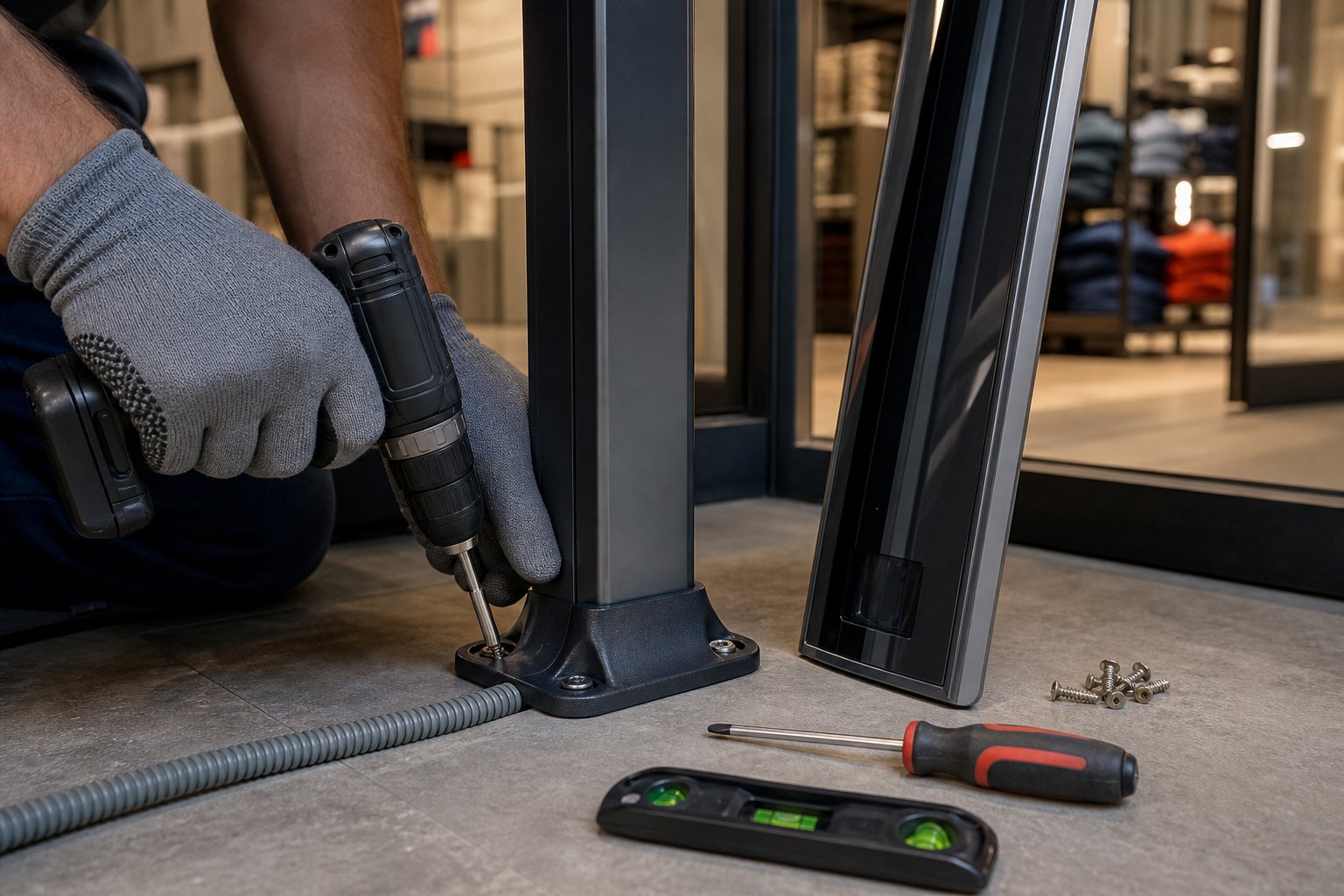
Alongside the gate itself, other components shape the day-to-day experience for staff: hard tags and soft labels matched to the material of each product, a fast magnetic detacher at the till (so queues do not build up), safer boxes for small, expensive items, and laptop locks for electronics displays. You can review the full range, with technical specifications for every model, at vista-eas.com.
Mistakes that cancel out the benefits
Installing a gate is not enough on its own. A few common mistakes turn the same equipment into a fresh source of tension:
- Constant false alarms: mounting the gate too close to sources of electrical noise, or setting the sensitivity wrong, produces alarms for no reason — and within days staff stop reacting to them altogether.
- No agreed response protocol: the team needs to know exactly what to say and do when the alarm goes off. Without it, you get back the very tension you were trying to remove.
- Partial tagging: if only some of the stock is tagged, staff still feel they have to keep an eye on the rest.
- A slow or single detacher: one detacher for three tills means queues, which means rushing, which means mistakes.
- Skipping routine servicing: a gate that is never recalibrated slowly loses range, and the team stops trusting it.
Where to start
Before you buy, pin down three things: the width of your entrance, the type and value of your highest-risk stock, and the average number of customers per hour at your busiest time. Those three numbers decide whether AM or RF suits you better, how many hard tags and labels you will get through each month, and how many detachers you need behind the tills. Getting that right on day one is the difference between a system that calms the team down and one that just adds noise.
The specialists at Vista Gate can recommend the right mix of gates, tags, labels and CCTV based on your store layout, and handle the site visit and installation if you need it. For a free consultation and a price quote, get in touch today through vista-eas.com — one short call can stop theft and give your sales team a calmer place to work.